Buyer's Guide
Indoor sauna buyer's guide: how to turn a spare room into a hot room
Choose the kind of sauna before the model. We set five brands' indoor cabins against the rooms and circuits they need, then added up a Nova 3.
By Adam Bognar, Editor

Decide which kind of indoor sauna you want before you pick a model, because each one asks something different of your house. The infrared cabins here plug into a 120-volt circuit and stay dry inside. A traditional cabin like Almost Heaven's Auburn or Sun Home's Nova 3 throws steam off hot stones, and it won't run until an electrician hardwires a 240-volt circuit for it. A room built into the house is a carpentry job first. We read the makers' manuals and warranties for nine cabins from five brands and set each one against the room it needs. Start your measuring at the ceiling. Sun Home wants two feet clear over the Nova so the wiring on its roof stays reachable, and that puts the ceiling at nearly nine feet.
Which kind of indoor sauna should you buy?
Buy a traditional cabin if you want to ladle water onto hot stones and your house can give it a 240-volt circuit and room to breathe. Buy an infrared cabin if you'd rather sit in dry heat, or if your panel's got no space for another 240-volt breaker. Build a room into the house when the space is an awkward shape or you want the sauna to look built in, and expect framing and insulation before you choose a heater.
We'd shortlist the infrared cabins by what each needs from the wall and what it costs once it's at your door: Sun Home's Equinox 2, Good Health's GHS-2X, Health Mate's Enrich 2 and Heavenly Heat's two-seater. Don't go by the seat count on the box. The two-person benches with published sizes run from about 41 to 45 inches wide, so check the spec sheet before you promise anyone a seat.
| Type | What it asks of your house | Examples in this guide |
|---|---|---|
| Freestanding infrared cabin | A dry, level floor with a few inches of air around it, and the 120V circuit its manual names, usually with nothing else on it | Sun Home Equinox 2; Good Health Saunas GHS-2X; Health Mate Enrich 2; Heavenly Heat 2-Person |
| Prefab traditional cabin | A hardwired 240V circuit, the clearances in its manual and a dry room its moist air can vent into | Sun Home Nova 3 and Nova 6; Almost Heaven Auburn, Madison and Patterson |
| Built-in traditional room | Walls and ceiling insulated behind a vapor barrier, vents planned with the heater and a hardwired 240V circuit | A room built around a heater such as HUUM's DROP or a Harvia KIP |
Requirements come from each maker's own documents, read Oct 7, 2026. The built-in room row follows the room-building section of HUUM's DROP heater manual.
Where in the house can an indoor sauna go?
A basement corner or a spare bedroom can take a cabin if it's dry and the cabin gets the space its maker asks for. We'd check the route in first. The Nova 3 arrives in a crate seven and a half feet tall, and Sun Home's assembly guide asks you to confirm every doorway and stairwell can pass a wall panel almost seven feet tall.
Each maker sets its own rules for the room. Sun Home's Equinox manual rules out closets and tight, unventilated spaces, though it lets the cabin stand on carpet. Almost Heaven wants its cabins off carpet and two inches from the walls. Sun Home's warranty is void for any of its saunas within five feet of a shower or tub, so measure from the plumbing before you plan one into a bathroom.
The space above a cabin means different things to different makers. Almost Heaven wants about a foot over the Auburn while you build it. Sun Home's two feet over the Nova are for the electrician and later service, and its spec sheet counts them in the space the cabin needs. Add your model's clearance to its height and you've got the lowest ceiling it'll fit under.
A walk-in closet can hold a compact kit like Almost Heaven's Madison. The Nova 3 belongs in what Sun Home's product page calls a finished room, and it'll need a tall ceiling.
| Cabin | Outside, W × D × H | Clear above | Around it | Power |
|---|---|---|---|---|
| Sun Home Nova 3 | 64.9 × 57.1 × 82.7 in | 24 in for electrical and service access | 12 in at the air intake; 24 in at the fan beside a finished wall; 30 in for the door; 20 in from wallpaper or other combustible coverings | 240V/30A, hardwired |
| Sun Home Nova 6 | 78.7 × 68.9 × 82.7 in | 24 in for electrical and service access | Same as the Nova 3 | 240V/40A, hardwired |
| Almost Heaven Auburn | 70 × 47 × 78 in | About 12 in while you assemble it | 2 in from walls | 240V/30A, hardwired; light on a 120V outlet |
| Almost Heaven Madison | 65 × 53 × 78 in | About 12 in while you assemble it | 2 in from walls | 240V/30A, hardwired; light on a 120V outlet |
| Sun Home Equinox 2 | 50.9 × 45.9 × 77.7 in | 12 in for airflow and troubleshooting access | 4 in at the sides; 6 in behind | Dedicated 120V/20A, NEMA 5-20, with GFCI protection |
| Heavenly Heat 2-Person | 47.2 × 41.3 × 75 in | 2 in | 2 in from walls | 120V NEMA 5-15 on its own circuit; 20A recommended |
| Health Mate Enrich 2 | 47.25 × 43.5 × 77 in | Not published | Not published | 120V NEMA 5-15, drawing about 15A |
| Good Health Saunas GHS-2X | 48 × 48 × 75 in | None required | None required; keep it off a cold outside wall | Dedicated 120V/20A, NEMA 5-20 |
From each maker's own documents, read Oct 7, 2026. Almost Heaven's sizes are Select Saunas' figures, which match Almost Heaven's own to within half an inch, and its clearances come from the FAQ on its indoor sauna pages.
Where to buy

Sun Home Saunas Indoor Saunas
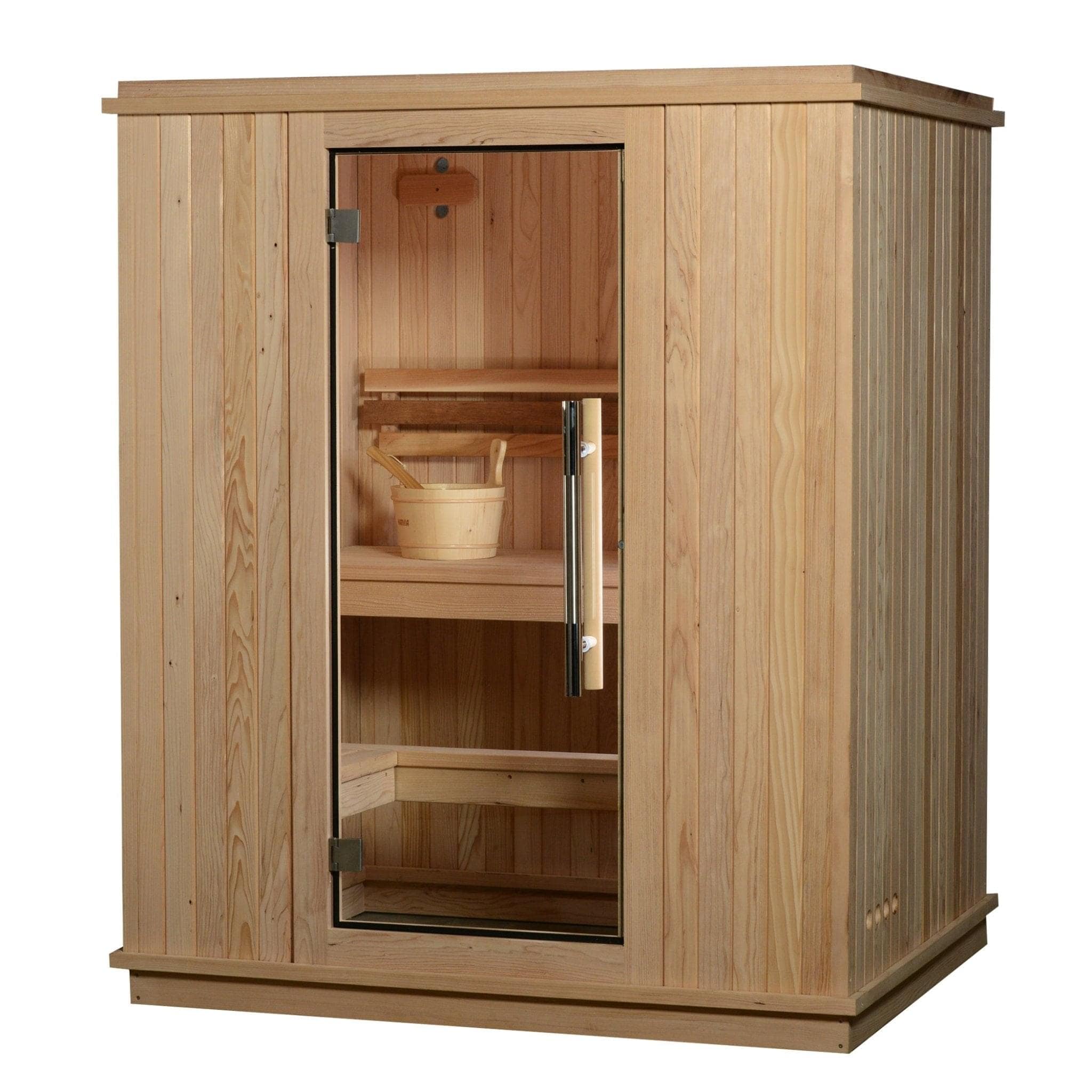
Sun Home Nova 3-Person Indoor Traditional Sauna
Almost Heaven Saunas Indoor Saunas
Almost Heaven Madison 2-3 Person Indoor Sauna


Sun Home Nova 3-Person Indoor Traditional Sauna. Sun Home Saunas photography.
See the specifications and priceSize the kit to the room you already have
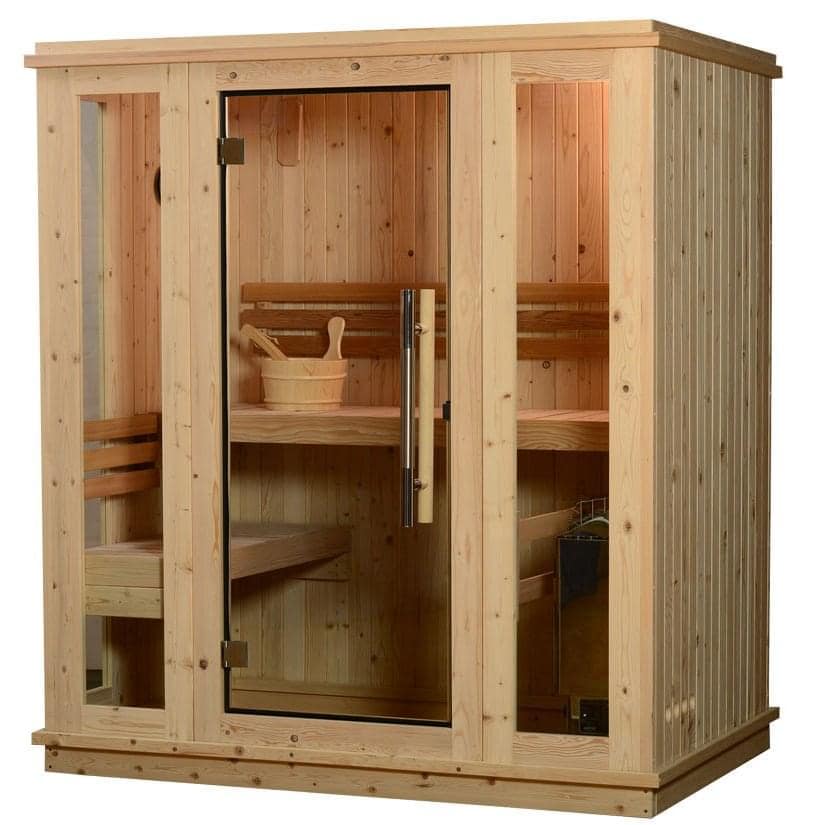
Almost Heaven's indoor kits show how much the floor plan sets the price. The Auburn and the Madison both seat two or three around the same 6 kW Harvia heater. The Auburn's long and shallow, close to six feet by four, and costs $4,260 at Select Saunas. The squarer Madison costs $4,786. We'd price the Auburn first, since it's cheaper and its top bench is about five inches longer.
Neither comes with a floor, so each stands on your existing one. They come to the curb on a 700-pound pallet after a six-to-eight-week build, and getting it inside is your job. Almost Heaven's warranty protects the room against defects for as long as the first owner has it, and Harvia covers the heater for five years and its elements for one.
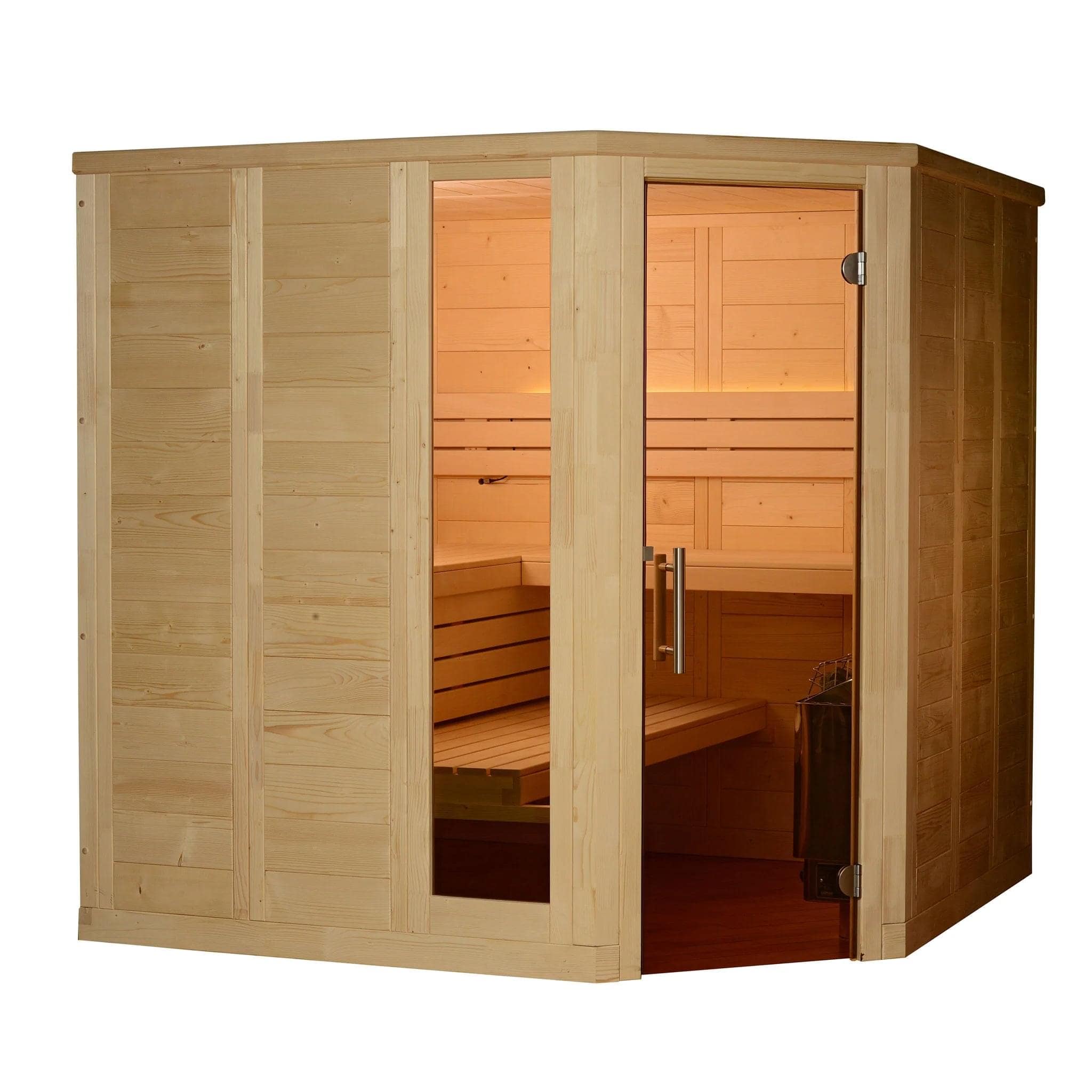
Step up to the six-person Patterson at $6,739 only if you'll fill it. It runs an 8 kW Harvia on a 40-amp circuit, which means heavier wiring and more power to heat a room that's mostly empty when there are two of you.
Where to buy
Almost Heaven Saunas Indoor Saunas
Almost Heaven Madison 2-3 Person Indoor Sauna
Almost Heaven Saunas Indoor Saunas
Almost Heaven Auburn 2-3 Person Indoor Sauna
Almost Heaven Saunas Indoor Saunas
Almost Heaven Patterson 6-Person Indoor Sauna
Sun Home's Nova pairs a cedar room with a HUUM stone heater
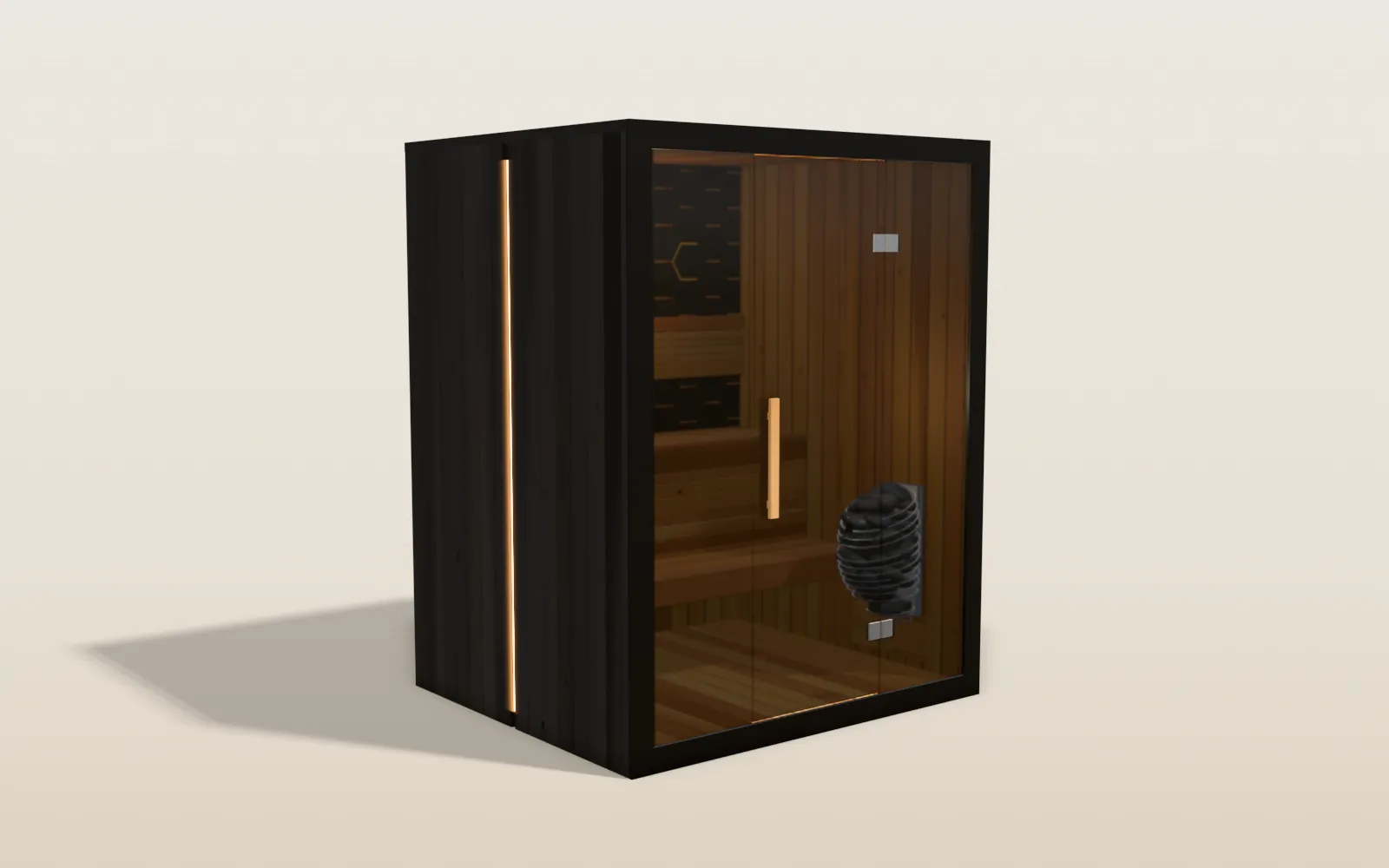
The Nova is Sun Home's first traditional sauna, and you put it together in the room from a kit. The Nova 3 seats three and costs $12,499 with HUUM's 6 kW DROP heater, and the six-person Nova 6 costs $16,399 with the 7.5 kW model. Sun Home rates both to about 230°F (110°C). Ladle water on the stones and the DROP sends back löyly, the wave of steam a stone heater's there to make. Japanese cedar lines the Nova 3 behind its black glass front.
A fan pulls damp air out one side and an intake under the heater lets fresh air in, so the cabin vents itself. HUUM's wall panel sets the heat, and Sun Home puts the warm-up at about an hour. The HUUM app needs a 2.4 GHz Wi-Fi network, though its ratings sit below 2.5 on the App Store and Google Play, so we'd count on the panel.
The Nova asks more of the room and the budget than any other cabin here. Besides the hardwired circuit, it needs two feet overhead, a foot on the intake side, two feet on the fan side when it faces a finished wall and 30 inches for the door. Sun Home's warranty treats a lifetime as seven years on the cabin and pays for parts only, never labor. HUUM covers the heater for three years and counts its elements as consumables, so a burned-out element is on you.
If the price stops you, Almost Heaven's Auburn gives you stones and steam for about a third as much, with a Harvia rated a little cooler at 194°F. It'll fit under a lower ceiling too.
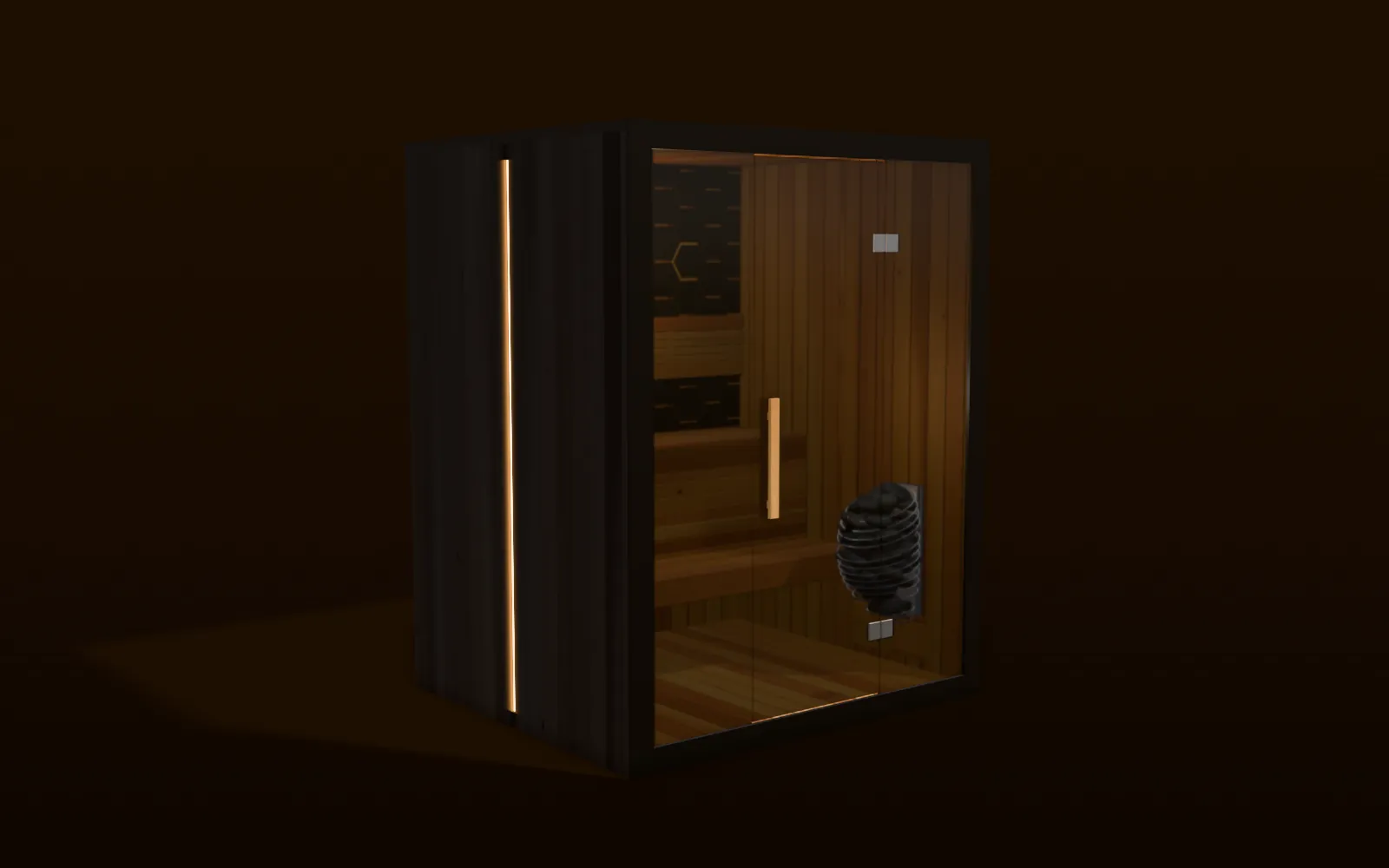
Outside
Sun Home uses thick black glass for privacy and says it holds the heat better. The door in the middle is a sheet of the same glass.
A cedar bar on each side of the glass makes the handle. Sun Home says the small gap around the door is there by design.
Sun Home heat-treats the cedar and finishes the outside in a water-based black stain it describes as low-VOC. The fasteners are marine-grade stainless steel, and a warm light strip runs up a groove in each side.
It runs on 240V, and a licensed electrician makes the connection. The heater and controls ship separately, and Sun Home wants every part on site before the electrician starts. Leave 12 inches on the right for the air intake and 30 inches in front for the door. Sun Home asks for two feet on the left only beside a finished wall, and two feet overhead so the electrician can reach the ceiling connections.
Inside
HUUM's DROP holds its stones in a ball of thin steel rings, and this one is the 6 kW model. Ladle water on the stones for steam. Sun Home rates the room to about 230°F and puts the heat-up at around an hour.
Sun Home pitches the pair as a hot upper zone and a milder lower one, so two bathers can pick their heat. Inside, the Nova 3 measures 59.1 by 53.5 inches.
Sun Home says the carbonized tiles are handcrafted in Estonia and laid by hand. Warm LEDs behind two of them light the joints around each one.
It sets the heat and the session. HUUM's app does the same over 2.4 GHz Wi-Fi once someone has confirmed at the panel that the room is safe, so the room can warm up before you're home.
Fresh air comes in through a grille low on the heater side, and the fan on the far wall pulls it across the room. Sun Home says to expect some warmth and humidity in the room around the sauna.
They run apart from the tile lights, and a remote changes the color.
We built this model from Sun Home's 3D tour and spec sheet, so small details can differ from the sauna that arrives.
Where to buy
Sun Home Saunas Indoor Saunas
Sun Home Nova 3-Person Indoor Traditional Sauna

Sun Home Saunas Indoor Saunas
Sun Home Nova 6-Person Indoor Traditional Sauna


Sun Home Nova 6-Person Indoor Traditional Sauna. Sun Home Saunas photography.
See the specifications and priceWhat does a Nova 3 cost by the time it's wired?
About $13,200 to $15,100 by our math, before anyone touches the room. Sun Home's list price includes every HUUM part from the heater and controls to the stones, and the cabin ships free to the curb in the US. We've added the bucket and ladle Sun Home sells for $85 and our own allowance of $600 to $2,500 for the 240-volt circuit, which stands in until you've got an electrician's quote.
Sales tax isn't in it, and neither is assembly. Sun Home's paid Room of Choice delivery stops once the pieces reach the room, by its shipping and assembly page, so someone still has to put the Nova together. Permits, a panel upgrade and any floor or vent work come on top. The same sum for Almost Heaven's Auburn stays under $7,000.
| Line | Sun Home Nova 3 | Sun Home Nova 6 | Almost Heaven Auburn |
|---|---|---|---|
| Sauna as sold, with its heater and controls | $12,499 | $16,399 | $4,260 |
| Bucket and ladle | $85 | $85 | A free bucket set from Select Saunas when we checked |
| Electrical circuit, our estimate | $600–$2,500 | $600–$2,500 | $600–$2,500 |
| Subtotal | $13,184–$15,084 | $17,084–$18,984 | $4,860–$6,760 |
| Freight | Free to the curb in the US | Free to the curb in the US | Free to the curb in the continental US, by Select |
| Assembly | Not included | Not included | Not included; two people in about six hours, by Select |
List prices read Oct 7, 2026, from Sun Home's store and Select Saunas. The circuit allowance is our estimate for a dedicated 240V circuit and stands in for an electrician's quote. The subtotal leaves out sales tax, assembly, carrying the pieces in, permits, a panel upgrade and any floor or ventilation work.
How big a heater does a built-in sauna room need?
As big as the heater maker's chart says for your room, with extra allowed for glass or tile. In a cabin kit that's already decided. Almost Heaven puts a 6 kW Harvia in the Auburn and the Madison, Sun Home puts HUUM's 6 kW DROP in the Nova 3, and those are the pairings each maker built the room around.
Build your own room and the heater's manual becomes the plan. HUUM's DROP manual gives each heater a range of room volumes and adds 3.3 cubic feet for every square foot of uninsulated glass or tile wall, because those surfaces soak up heat. It also says the warranty won't hold if the heater doesn't match the room's calculated volume.
The same manual sketches the room around it. HUUM recommends a ceiling between about six foot seven and seven foot seven. Walls and ceiling get insulation behind a vapor barrier, and the vents should change the air about six times an hour. Get a contractor to price that shell before you order a heater.
Both Harvia heaters below are 8 kW models, and neither price includes the Harvia controller it needs. Harvia pitches the Cilindro, with its open stack of stones, for softer steam.
Where to buy


Harvia Heaters & Stoves
Harvia Cilindro PC80E 8kW Electric Sauna Heater
“Stone packed around the elements lets this tower make about as much steam as a home electric heater can.”
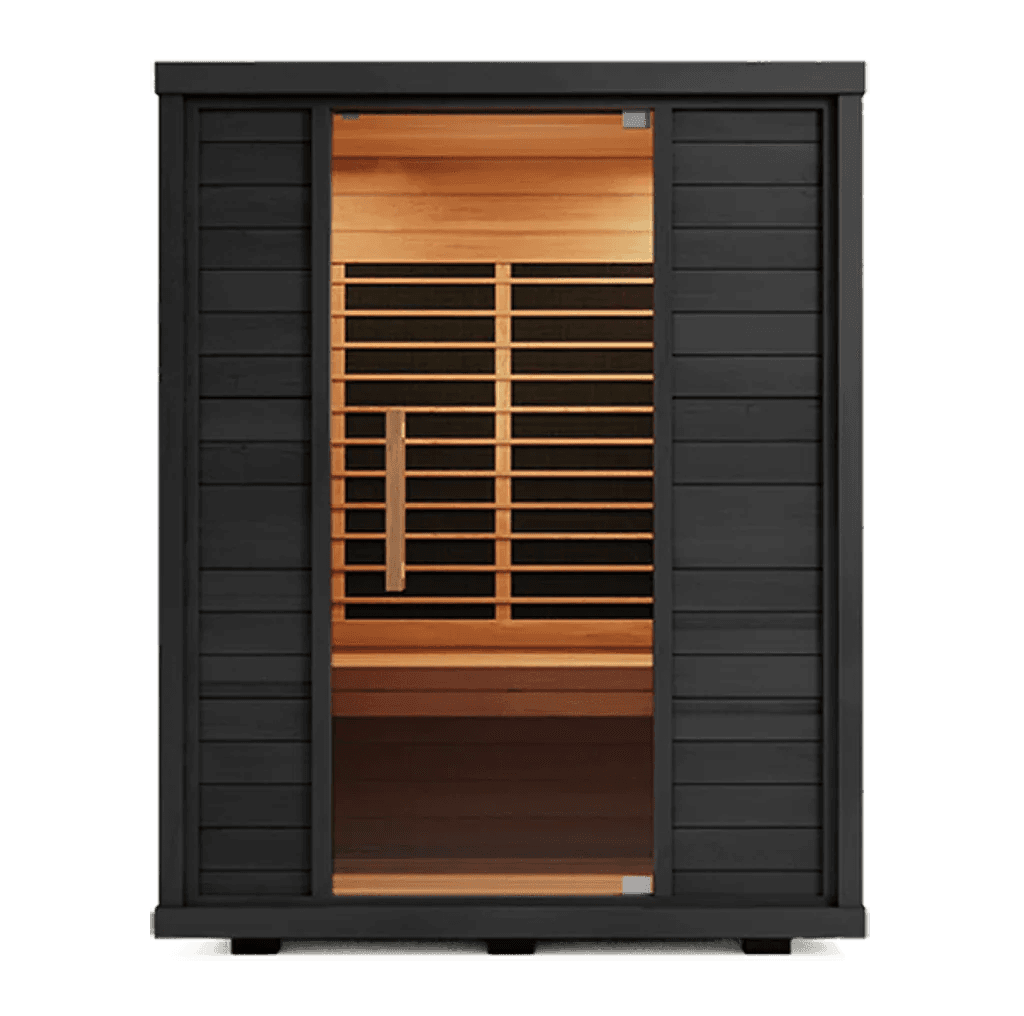
Sun Home's Equinox 2 is the infrared cabin we'd start with
The Equinox 2 is our infrared guide's pick, and it's easy on a room. It's a little over four feet wide and needs a few inches of air around it and a foot above, so about seven and a half feet of ceiling does it. It costs $6,799 and wants a dedicated 20-amp circuit at 120 volts with GFCI protection, which an electrician can add if your panel has space.
Its weak spot is a slow warm-up in the kind of room this guide is about. Sun Home's manual allows 30 to 45 minutes and names an unheated garage or basement and a concrete floor as things that slow it further. The two full-spectrum heaters by the door can burn you if you touch them, by the same manual. The cabinetry and heaters carry a seven-year warranty.
Where to buy
Sun Home Saunas Infrared Saunas
Sun Home Equinox 2-Person Full-Spectrum Infrared Sauna
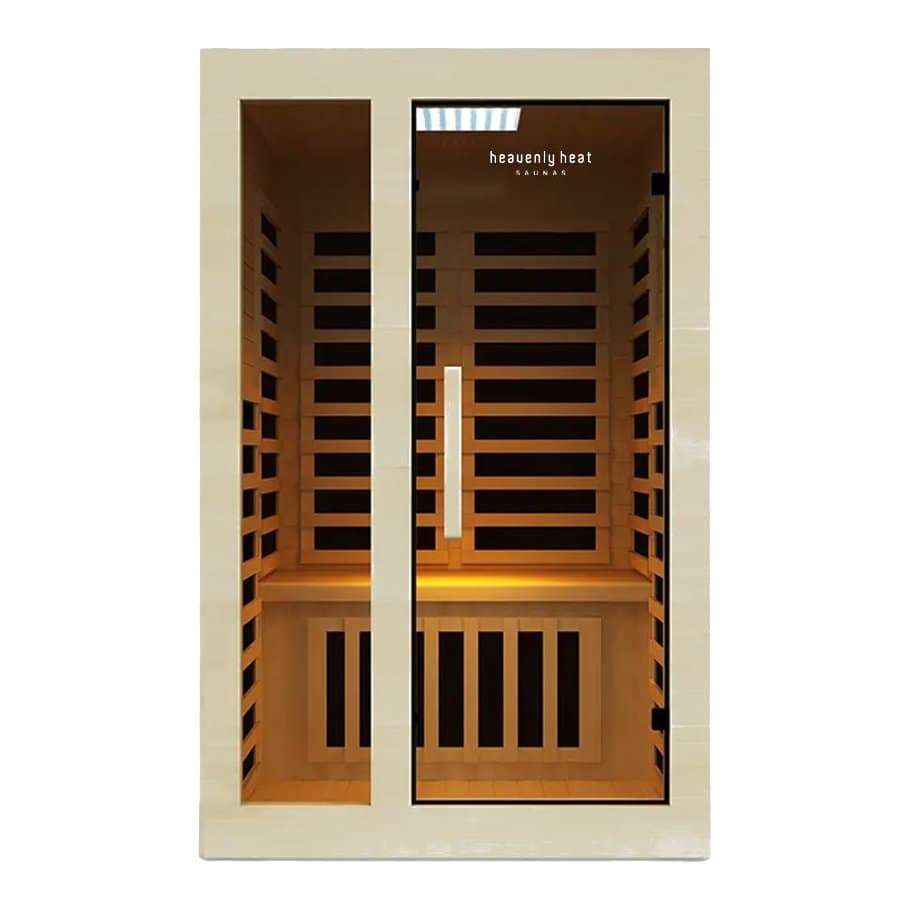
Heavenly Heat's two-person cabin fits under a seven-foot ceiling
Heavenly Heat's far-infrared cabin is 75 inches tall and wants a two-inch gap to the walls and ceiling, so by its own figures it fits under a seven-foot basement ceiling. It's solid Canadian hemlock throughout, with no plywood and no glue, for $7,400. Its manual says it needs no venting and can sit on carpet, as long as the room stays dry.
Delivery's the weak spot. Freight stops at the curb, and Heavenly Heat's shipping terms say even the paid assembly service won't carry the boxes in, so line up help for a 320-pound cabin and the stairs. It takes an ordinary 15-amp plug, though its maker would rather you gave it a 20-amp circuit with nothing else on it. Its warranty gives the cabin and heaters ten years and excludes labor.
Where to buy
Heavenly Heat Saunas Infrared Saunas
Heavenly Heat 2-Person Far Infrared Sauna
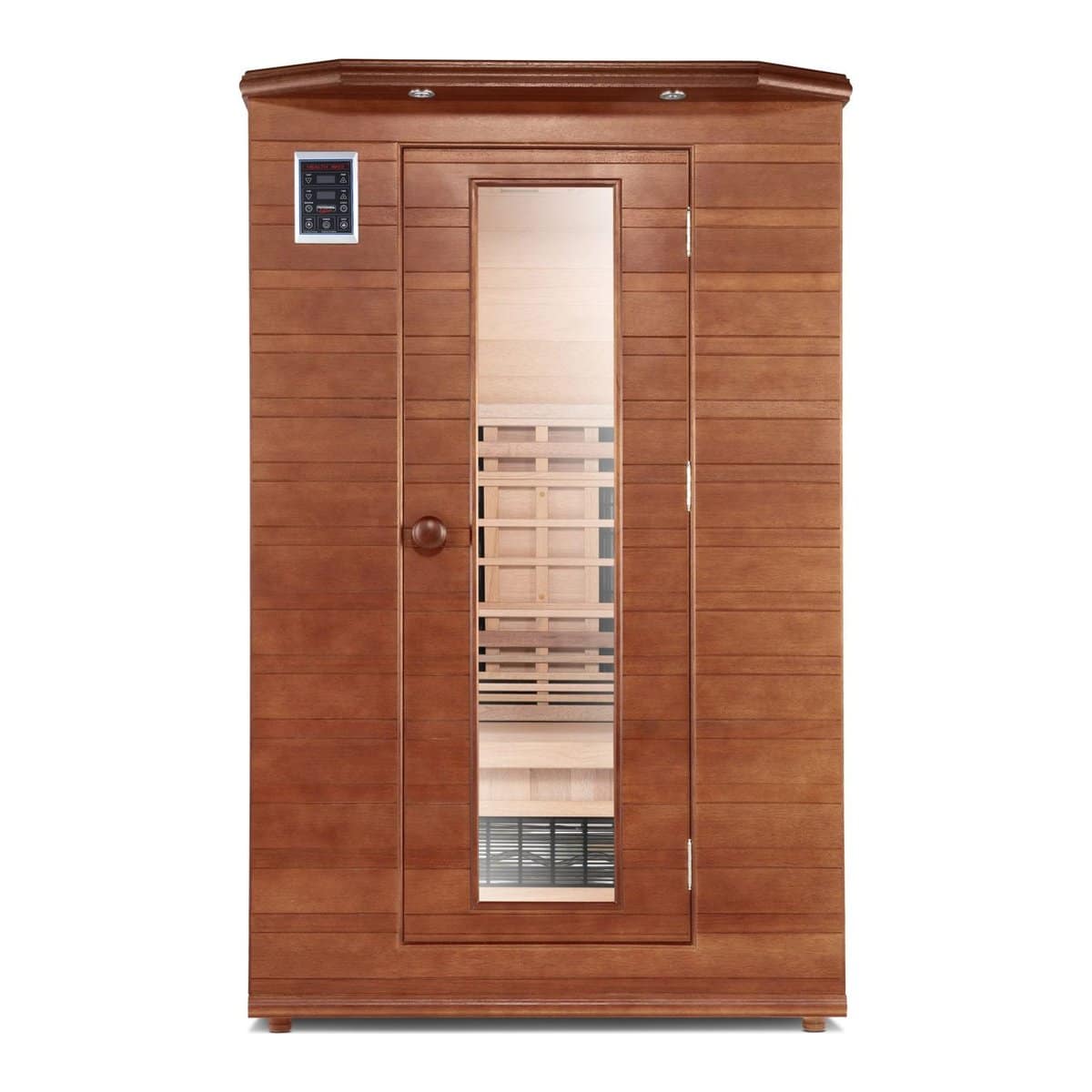
Health Mate's Enrich 2 plugs into a standard outlet for $5,300
Of the cabins here that plug into the wall, the Enrich 2 is the cheapest with a published price. It's Indonesian mahogany, with eight heaters around the walls and floor and a near-infrared LED panel overhead, and its magnetic panels go together without tools, by Health Mate's manual.
Its plug is a standard 15-amp one, and the cabin uses nearly all of that. At Health Mate's rated 1,780 watts it pulls close to 15 amps at 120 volts by our math, so nothing else can share the circuit. Free delivery ends at the curb, and Health Mate doesn't publish the bench size, so we'd ask before counting on two adults side by side. Health Mate guarantees the heater core for life, and the cabin gets ten years.
Where to buy
Health Mate Infrared Saunas
Health Mate Enrich 2 Full-Spectrum Infrared Sauna
Good Health's GHS-2X is a hybrid because it mixes infrared heaters
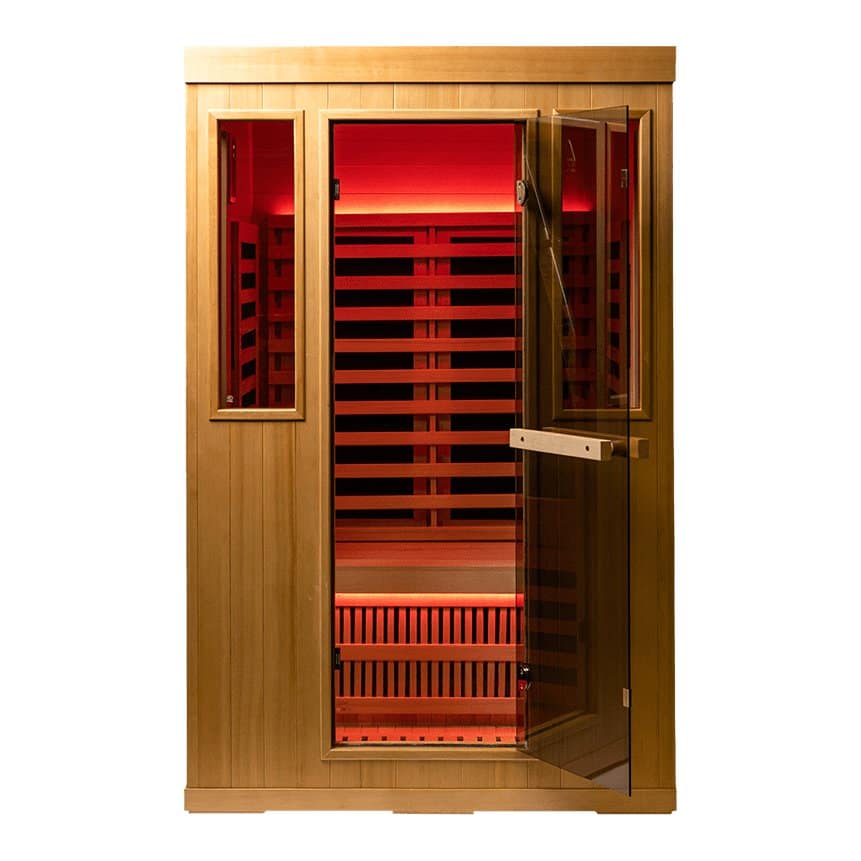
In Good Health Saunas' catalogue, hybrid means a mix of infrared elements, and there are no stones to ladle. The GHS-2X sets carbon panels behind you and near your feet, with alloy elements facing you, in a hemlock or red cedar cabin four feet square. Its spec sheet wants a dedicated 20-amp circuit at 120 volts.
Good Health won't show a price until you fill in a form, so ask for a written quote that includes delivery. Its warranty page promises lifetime cover on the heaters and electrical parts and doesn't mention the cabin. That page also claims two-person saunas usually run off a 15-amp outlet. The spec sheet asks for 20 amps, so wire to that. Good Health's FAQ suggests keeping it off a cold outside wall so it heats faster.
Where to buy
Good Health Saunas Infrared Saunas
Good Health Saunas GHS-2X Hybrid 2-Person Infrared Sauna
What should you get in writing before you order?
Get each part of the job priced separately and in writing, and ask each person what their number leaves out. A job split across trades is easy to pay for twice, or to leave a gap in. Your electrician works to the National Electrical Code as your town has adopted it, so ask whether the circuit needs a permit.
| Quote | Who gives it | Ask whether it covers |
|---|---|---|
| Delivered sauna | The store or the maker | Everything in the box, and whether freight stops at the curb |
| Assembly | The maker or a carpenter | Carrying the pieces to the room and hauling the crate away |
| Electrical | A licensed electrician | The circuit the heater's manual names, plus the permit and any panel upgrade |
| Room and floor | A contractor | Leveling the floor and any wall or ceiling work around the cabin |
| Ventilation | A contractor | Supply and exhaust vents for a built-in room, or a way out for a cabin fan's moist air |
| Approvals | Your local building department | Whether the circuit or a built-in room needs a permit and an inspection |
Ask each supplier for its full scope in writing, so nothing gets counted twice or left out.
How did we put this guide together?
We checked nine cabins from five brands, plus two Harvia heaters for built-in rooms, against their makers' own documents as of Oct 7, 2026. That meant every spec sheet and manual we could find, along with assembly guides and written warranties, and HUUM's DROP manual for the built-in room. We couldn't find an independent test that puts these cabins side by side, so the temperatures and clearances here are the makers' figures.
Sun Home's prices are list prices from its own store, which was running a sale that week. Almost Heaven's come from Select Saunas on the same day, except the Patterson's, which we read on Oct 5, 2026. Owner reviews are thin for the Nova, with five for the Nova 3 and seven for the Nova 6 on Sun Home's store, too few to call a pattern. Our $600 to $2,500 circuit allowance is the same range our running-cost guide works from.
Common questions
- Can I put an indoor sauna in a basement?
- Usually, yes, if it's dry and the cabin fits down the stairs. Sun Home's Nova guide asks for a dry, temperature-controlled room, and Heavenly Heat wants its infrared cabin below 85 percent humidity. Measure the stairway and every turn before you order, and fix any damp first. Sun Home's Equinox manual warns that a cold basement or a concrete floor slows the warm-up.
- How much ceiling height does an indoor sauna need?
- Add the cabin's height to the clearance its maker asks for above it. Sun Home's Nova is 82.7 inches tall and needs 24 inches above it for electrical and service access, so plan on a room close to nine feet high. Almost Heaven's Auburn is about 78 inches tall and wants roughly a foot above it only during assembly. Heavenly Heat's two-person infrared cabin needs 77 inches in all.
- Does an indoor sauna need a drain or a vapor barrier?
- A built-in traditional room needs a vapor barrier, and HUUM's heater manual puts one behind the insulation in the walls and ceiling. A freestanding cabin has its own walls, and none of the cabin documents we read asks for a vapor barrier or a floor drain around it. Infrared cabins stay dry inside, and Sun Home says to unplug an Equinox if water gets in.
- Will an indoor sauna cause moisture problems?
- It can if the steam has nowhere to go, so follow the cabin's manual on clearances and venting. A traditional sauna adds moisture each time you ladle. Sun Home's Nova blows it out through a fan on one side, and Sun Home wants 24 inches between that side and any finished wall. Almost Heaven says its vented cabins need nothing more from the room, and either way the room should be dry to begin with.
- Can I plug an indoor sauna into an existing outlet?
- Sometimes, for an infrared cabin, if the circuit matches its manual and nothing else is on it. Health Mate's Enrich 2 and Heavenly Heat's two-person cabin take a standard 15-amp plug, and Sun Home's Equinox 2 and Good Health's GHS-2X need a dedicated 20-amp circuit and outlet. Traditional cabins such as the Sun Home Nova and the Almost Heaven Auburn have no plug, so an electrician hardwires them at 240 volts.
- How much does an indoor sauna cost?
- The cabins with published prices in this guide run from $4,260 for Almost Heaven's Auburn at Select Saunas to $16,399 for Sun Home's Nova 6, and those prices leave out wiring and assembly. By our math, a Sun Home Nova 3 comes to about $13,200 to $15,100 with its bucket and ladle and an estimated $600 to $2,500 for the circuit, before sales tax and putting it together.
- Does the Sun Home Nova need an electrician?
- Yes. The Sun Home Nova has no plug, so a licensed electrician hardwires it to a dedicated 240-volt circuit, on a 30-amp breaker for the Nova 3 and a 40-amp one for the Nova 6. Sun Home ships the HUUM heater and controls separately and asks you to wait for both deliveries before the electrician starts.
Sources
- 1.NFPA 70: National Electrical Code (NEC). National Fire Protection Association, 2023.
We review from makers’ documentation, owner reports and published research. How we choose products and write reviews.
We may earn a commission or a fee from brands in this guide. Our picks are our own. How we make money.