The Big Comparison
Infrared vs. traditional sauna: which one should you buy?
A traditional sauna gives you a hot room and steam, and infrared runs milder and is often easier to wire. We weigh both against what the research shows.
By Adam Bognar, Editor
Buy a traditional sauna if you want a hot room and steam rolling off the stones. An infrared cabin makes more sense if you'd rather sit longer in milder air, and it usually asks less of your electrician and your power bill. The research can't settle it for you. The long-term studies followed Finns who bathed in traditional saunas, and a Japanese trial of far-infrared therapy treated heart-failure patients in hospital, so neither shows that one kind of sauna is healthier at home. We set six saunas from five brands side by side, three of each kind, and read each maker's paperwork on them down to the warranty terms. We also read the studies themselves, which say less than the marketing that quotes them.
How do infrared and traditional saunas compare?
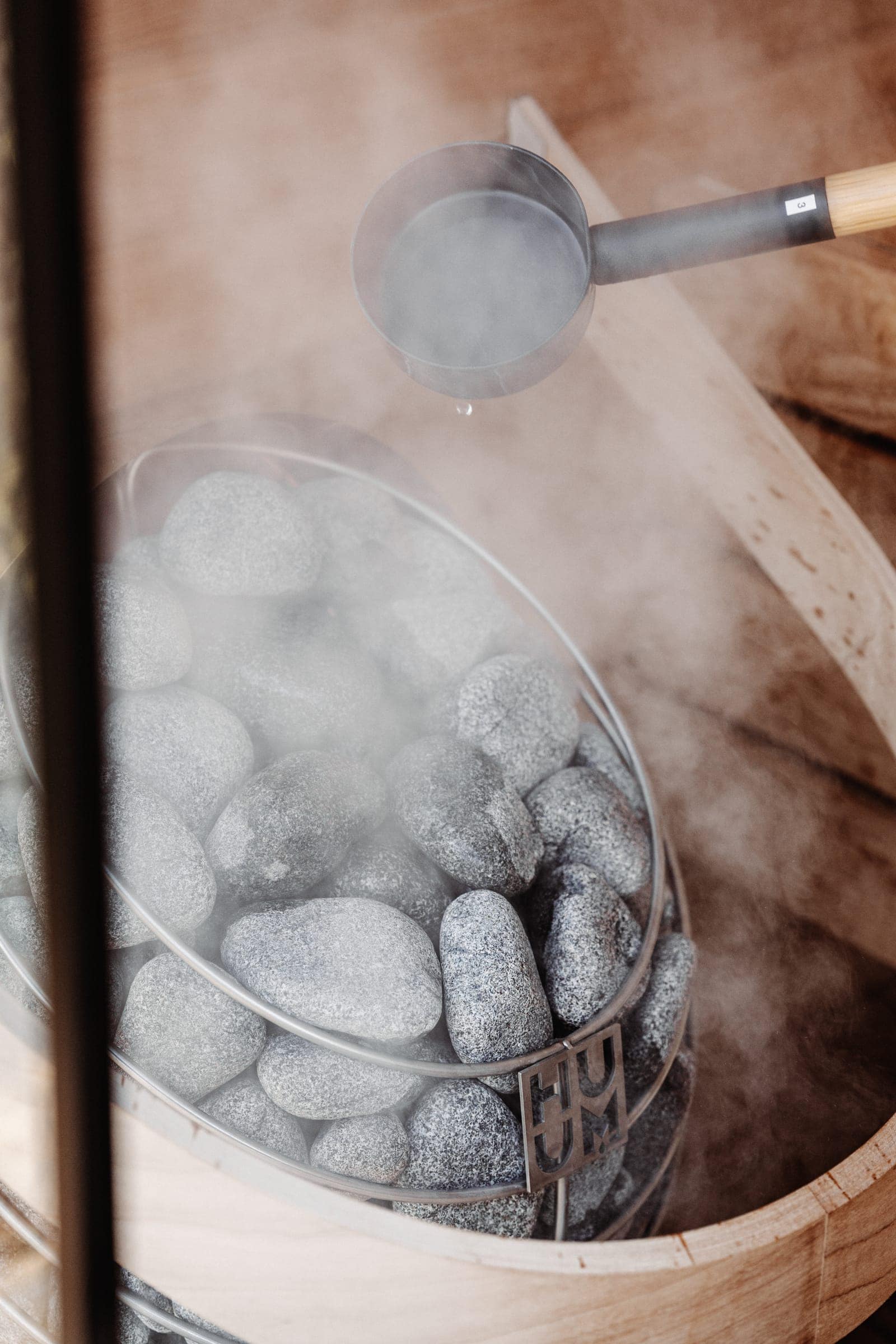
A traditional sauna heats the room. Its heater warms the air and a load of stones, and water ladled onto the stones turns to löyly, which rolls down over the benches as a burst of humid heat. Infrared panels aim their heat at you and the wood around you, so the air stays drier and cooler while you sweat.
Most of the other differences follow from that, from how long people stay in to the job your electrician quotes for. The table sets the two side by side using the saunas in this piece.
| Traditional | Infrared | |
|---|---|---|
| How it heats | A heater warms the air and a load of stones | Panels send radiant heat into you and the wood |
| Usual air temperature | 80–100°C (176–212°F) at face height | About 60°C (140°F) for far-infrared |
| Top rating in this piece | About 230°F, Sun Home's rating for the Nova | 150–170°F on the makers' thermostats |
| Steam | Water on the stones makes löyly | None; the air stays dry |
| Long-term research | Observational cohorts of Finnish bathers, which show associations | Small clinical trials such as WAON-CHF in heart-failure patients |
| Electrical | Hardwired 240V on a 30–50A breaker for the electric heaters here; a wood stove needs a chimney | From a 15A plug at 120V up to a 30A twist-lock at 240V, by model |
| Prices in this piece | $4,786–$16,399 | $1,999–$13,599, plus one by quote |
| Energy per session, by our math | About 8 kWh for a 6 kW heater | About 2.2 kWh for Sun Home's 1.88 kW Equinox 2 |
Air temperatures are typical room ranges, from the JAMA Internal Medicine paper on the Finnish cohort (traditional) and a 2009 review in Canadian Family Physician (far-infrared). They describe the air, and your body stays far cooler. Top ratings are the makers' own. Energy figures use the assumptions in the running-cost table below, and prices are list prices we read on Oct 7, 2026.
Is a traditional sauna healthier than an infrared one?
The research can't answer that. Most of the long-term sauna evidence comes from the KIHD study in eastern Finland, which followed people who bathed in traditional saunas. Men who bathed four to seven times a week had fewer sudden cardiac deaths than the once-a-week bathers, and later papers from the same project found lower rates of stroke and dementia among frequent bathers.
Those are associations. Each person reported their sauna habit once, at the start, and the authors note that frequent bathers may differ in ways their adjustments missed, so the papers can't show that the sauna caused the gap. They don't speak for infrared either. The authors of the stroke paper wrote that their finding can't be applied to infrared heat.
Most of infrared's trial evidence comes from heart medicine. WAON-CHF put hospital patients with advanced heart failure through ten supervised far-infrared sessions, and the heart-strain marker it set out to lower fell no further than with usual care. Patients did walk farther. None of these studies tested a home cabin. The table keeps each one with the people it studied.
| Study | Who was studied | Sauna | Design | What it found |
|---|---|---|---|---|
| JAMA Internal Medicine (2015), Laukkanen and colleagues | 2,315 men aged 42–60 in eastern Finland over a median 20.7 years | Traditional Finnish sauna | Observational cohort (KIHD) | Men who bathed 4–7 times a week had a 63% lower risk of sudden cardiac death than once-a-week bathers, from 10 deaths among 201 men |
| Neurology (2018), Kunutsor and colleagues | 1,628 men and women aged 53–74 in eastern Finland over a median 14.9 years | Traditional Finnish sauna | Observational cohort (KIHD) | 4–7 sessions a week went with a 61% lower stroke risk than one; the authors say the result can't be applied to infrared |
| Age and Ageing (2017), Laukkanen and colleagues | The same 2,315 men as the JAMA paper over a median 20.7 years | Traditional Finnish sauna | Observational cohort (KIHD) | 4–7 sessions a week went with a 66% lower dementia risk than one, from 8 cases in that group |
| Circulation Journal (2016), Tei and colleagues: the WAON-CHF trial | 149 hospital patients with advanced heart failure in Japan | Far-infrared Waon chamber at 60°C, then 30 minutes under a blanket | Randomized trial of 10 supervised sessions over 2 weeks | The heart-strain marker BNP fell no more than with usual care, so it missed its main target; patients walked farther |
The three Finnish papers are observational, so they show associations in the people studied and can't show cause. Each compared frequent bathers with once-a-week bathers, and none of the four studies tested a home sauna.
How hot does each kind of sauna get?
A traditional room runs much hotter, usually somewhere between 80 and 100°C at face height. Far-infrared cabins sit nearer 60°C, according to a review in Canadian Family Physician. Those are air temperatures, and your body doesn't get anywhere near them in either room.
A maker's top rating is a ceiling, and the room won't always reach it. Sun Home rates the Equinox 2 to 165°F, and Dynamic's own manual expects its Barcelona to fall short of the 150°F on its dial.
How long people stay in differs too. Sun Home's manual calls 20 to 40 minutes a typical Equinox session and recommends no more than that. Traditional bathers tend to go in rounds and step out to cool off between them, and in the Finnish cohort anything over 19 minutes counted as a long session.
Which costs less to install and run?
Infrared usually costs less on both counts, though the wiring depends on the model. Sun Home's manual puts the Equinox 2 on a dedicated 20-amp circuit at 120 volts. The Eclipse 2 wants a 30-amp twist-lock outlet, which most homes would need an electrician to add.
An electric traditional heater is a bigger job. The Nova 3's heater hardwires to a 240-volt line on a 30-amp breaker, and Nootka's wants an even bigger breaker. Either way, you'll need a licensed electrician to run the circuit. A wood stove skips the circuit and needs a chimney.
To work out running cost, multiply the heater's kilowatts by the hours it draws full power, then by your rate per kWh. The table runs one session of each kind on our own assumptions, so swap in your heater and your rate. The hour of warm-up eats three-quarters of the traditional room's energy in our example, which makes a second round cheap once the room's hot.
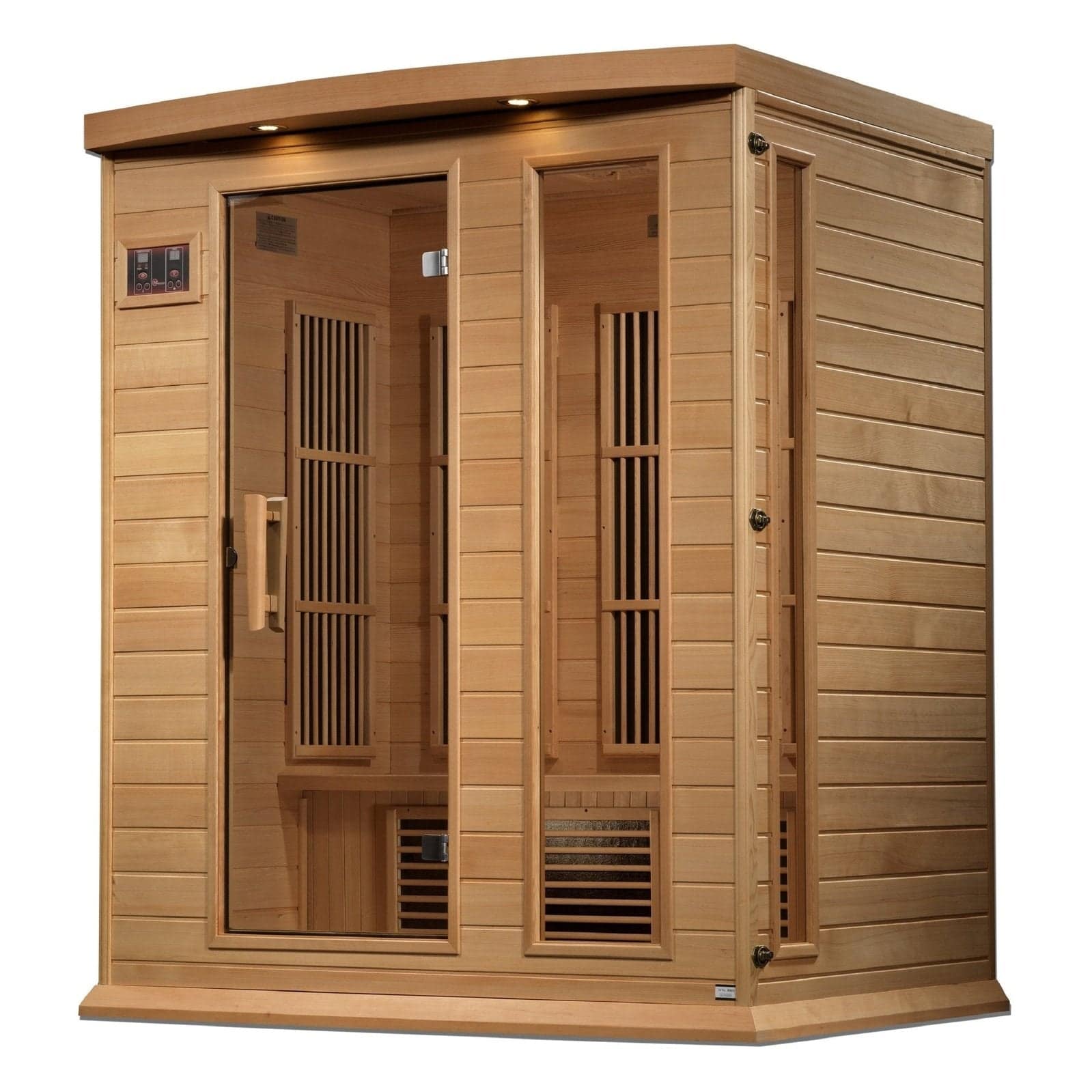
Infrared's also the cheaper way in. Dynamic's Barcelona costs $1,999, and its manual wants a 15-amp circuit of its own. By Dynamic's own figures it runs cool, and two people sit shoulder to shoulder on its bench. Golden Designs owns both Dynamic and Maxxus, and its three-person Maxxus cabin costs $3,699.
| Assumption | Infrared: Sun Home Equinox 2 | Traditional: Sun Home Nova 3 |
|---|---|---|
| Heater's rated draw | 1.88 kW, from Sun Home's spec sheet | 6 kW HUUM DROP, from Sun Home's spec sheet |
| Warm-up | 30 minutes, the low end of Sun Home's manual | 1 hour, Sun Home's figure |
| Time in the room | 40 minutes | 40 minutes |
| Share of time at full power | Full draw from start to finish | Full draw to warm up, then half the session |
| Energy per session | About 2.2 kWh | About 8 kWh |
| Cost per session at 18¢ a kWh | About 39¢ | About $1.44 |
| Four sessions a week | About $7 a month | About $25 a month |
We chose every input except Sun Home's heater ratings and warm-up figures. The rate sits near the EIA's US residential average for July 2026, 18.31¢ a kWh, and a month here is 17.3 sessions. Energy is rated kW × hours × the share at full power. A thermostat that cycles more, a warm room or a shorter stay lowers the figure, and a cold garage raises it. If the Nova's heater never cycled off, a session would use 10 kWh and cost $1.80.
Where to buy
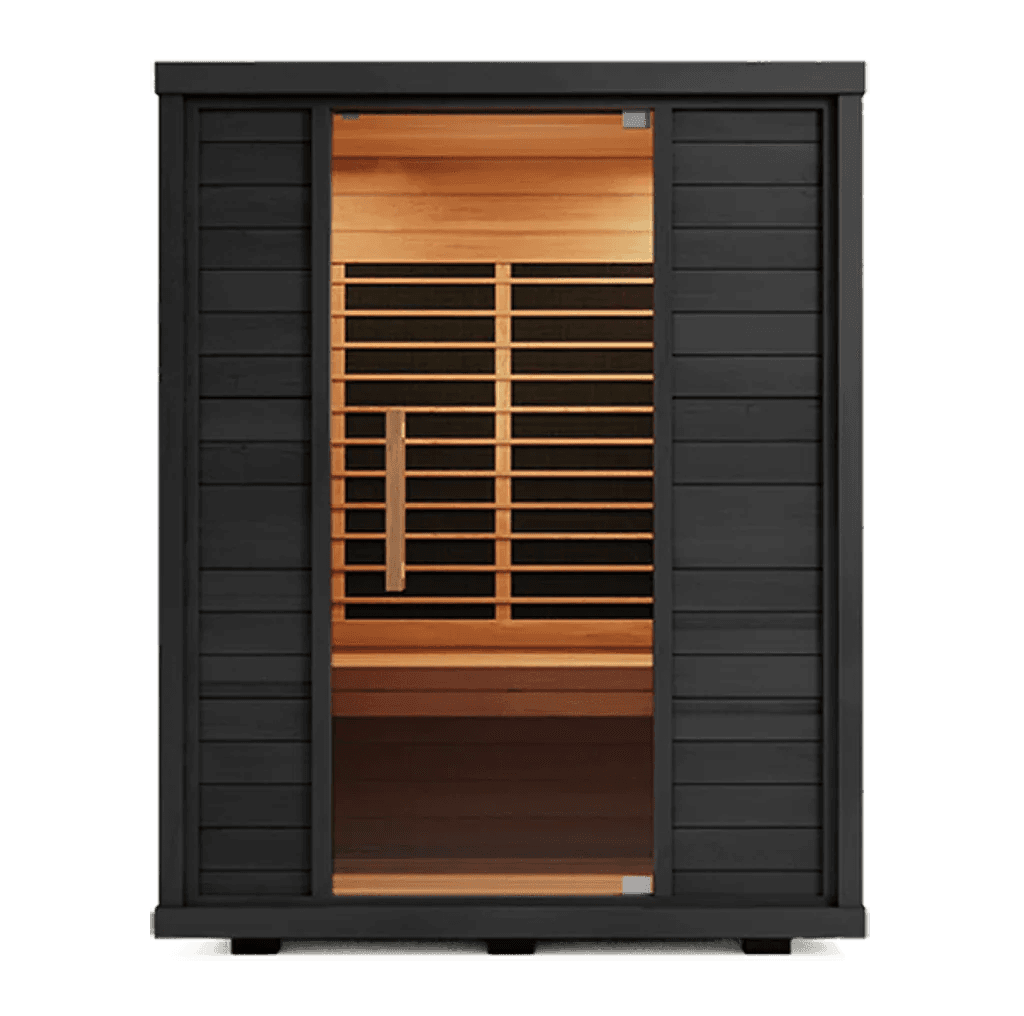
Sun Home Saunas Infrared Saunas
Sun Home Equinox 2-Person Full-Spectrum Infrared Sauna
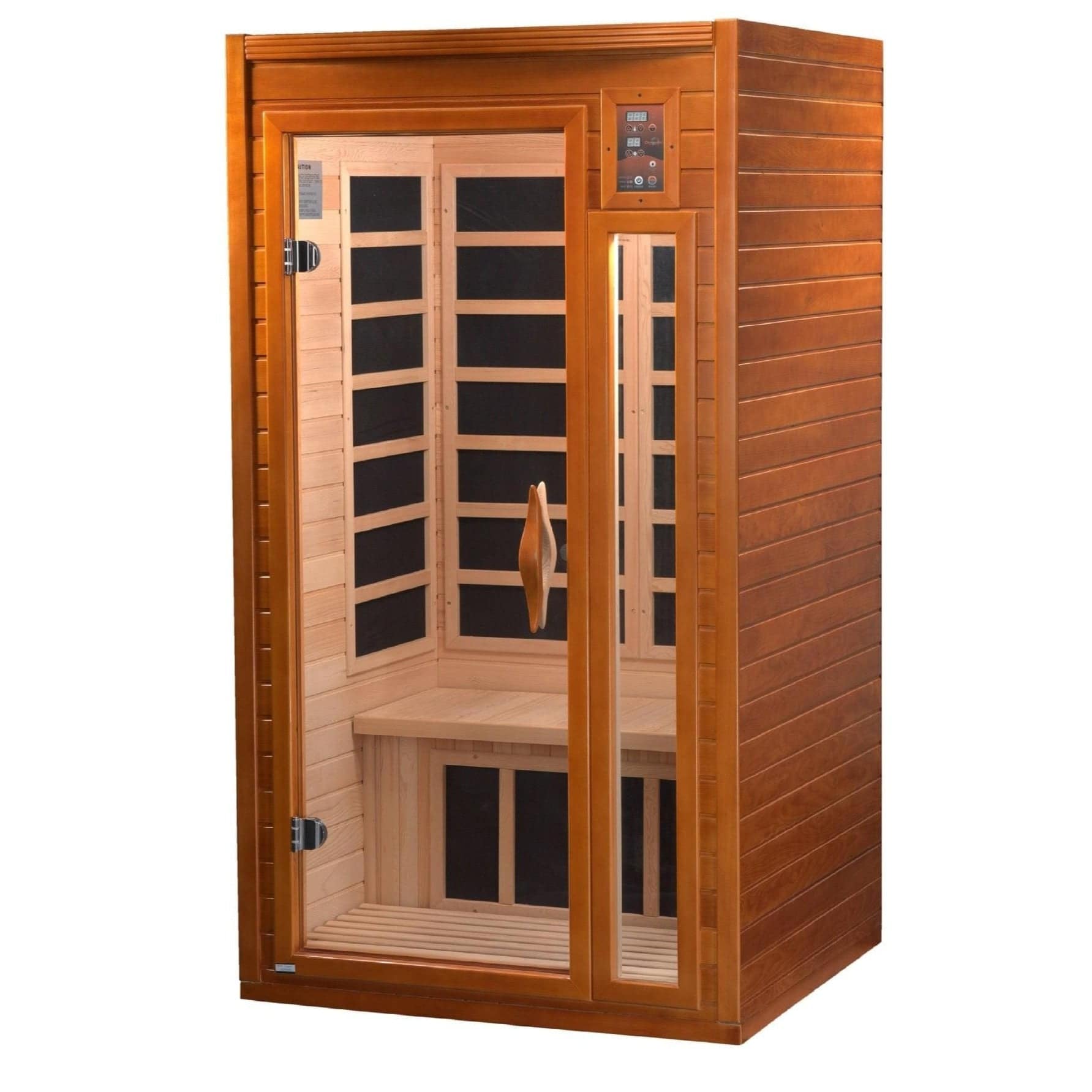
Dynamic Saunas Infrared Saunas
Dynamic Saunas Barcelona 1-2 Person Low EMF Far Infrared Sauna
Maxxus (Golden Designs) Infrared Saunas
Maxxus 3-Person Near-Zero EMF Far Infrared Sauna MX-K306-01-ZF


Sun Home Equinox 2-Person Full-Spectrum Infrared Sauna. Sun Home Saunas photography.
See the specifications and priceHow much does each kind cost, and what's included?
Prices overlap more than the two labels suggest. Almost Heaven's Madison comes with its heater and still costs less than any Sun Home cabin in this piece. Where the two kinds part ways is the bill after delivery. Each electric traditional room here needs an electrician for a 240-volt line. Most of the infrared cabins plug in, though several want a new circuit, and Sun Home reckons two people can put one of its indoor cabins up in about two hours.
The table lists what each price covers and what it leaves to you, so you can compare like with like. Freight to the curb is common, and getting the pieces inside is usually your job.
| Model | Heat | Price | Included | Not included |
|---|---|---|---|---|
| Sun Home Nova 3 | Traditional, indoor | $12,499 | Cabin kit; 6 kW HUUM heater with controller and stones; free curbside freight | Assembly; an electrician for a hardwired 240V/30A circuit; bucket and ladle ($85) |
| Almost Heaven Madison | Traditional, indoor | $4,786 at Select Saunas | Pre-built wall and roof sections; 6 kW Harvia heater with dial controls and stones; free curbside freight | Assembly; an electrician for a 240V/30A circuit; the floor |
| Nootka Cube | Traditional, outdoor | $13,250–$14,340 | Cedar room; 9 kW heater with stones and a basic touchscreen; metal roof and large window | Freight and assembly (added at checkout); an electrician for a 50A circuit; app control ($375) |
| Sun Home Equinox 2 | Infrared, indoor | $6,799 | Cabin with 4 far-infrared panels and 2 full-spectrum heaters; free curbside freight | Assembly (about 2 hours, Sun Home says); a dedicated 120V/20A circuit with GFCI |
| Good Health Saunas GHS-2X | Infrared, indoor | By quote | Cabin with 10 heating elements; control panel; chromotherapy lighting | Delivery and installation (quoted with the price); a dedicated 120V/20A circuit |
| Health Mate Enrich 2 | Infrared, indoor | $5,300 | Cabin with 8 heaters and a near-infrared LED panel; free curbside delivery | Inside delivery (quoted separately); a 15-amp circuit to itself, by our math |
Inclusions come from what each maker publishes, and from Select Saunas' listing for the Madison. Prices are list prices from Oct 7, 2026. Sun Home was running a sale that week. Nootka's range covers its door and controller options in US dollars.
Sun Home's Nova is our pick for an indoor traditional sauna
If you want löyly and the full Finnish ritual, you're shopping for a hot-rock sauna, and the first choice is indoors or out.
For a hot-rock room inside the house, we'd buy Sun Home's Nova if the budget reaches $12,499. The Nova 3 heats with a 6 kW HUUM DROP stone heater that Sun Home rates to about 230°F (110°C), and Sun Home says the room takes about an hour to heat. HUUM's heater and controller arrive with the stones in a separate box, and Sun Home wants both shipments on site before the electrician starts.
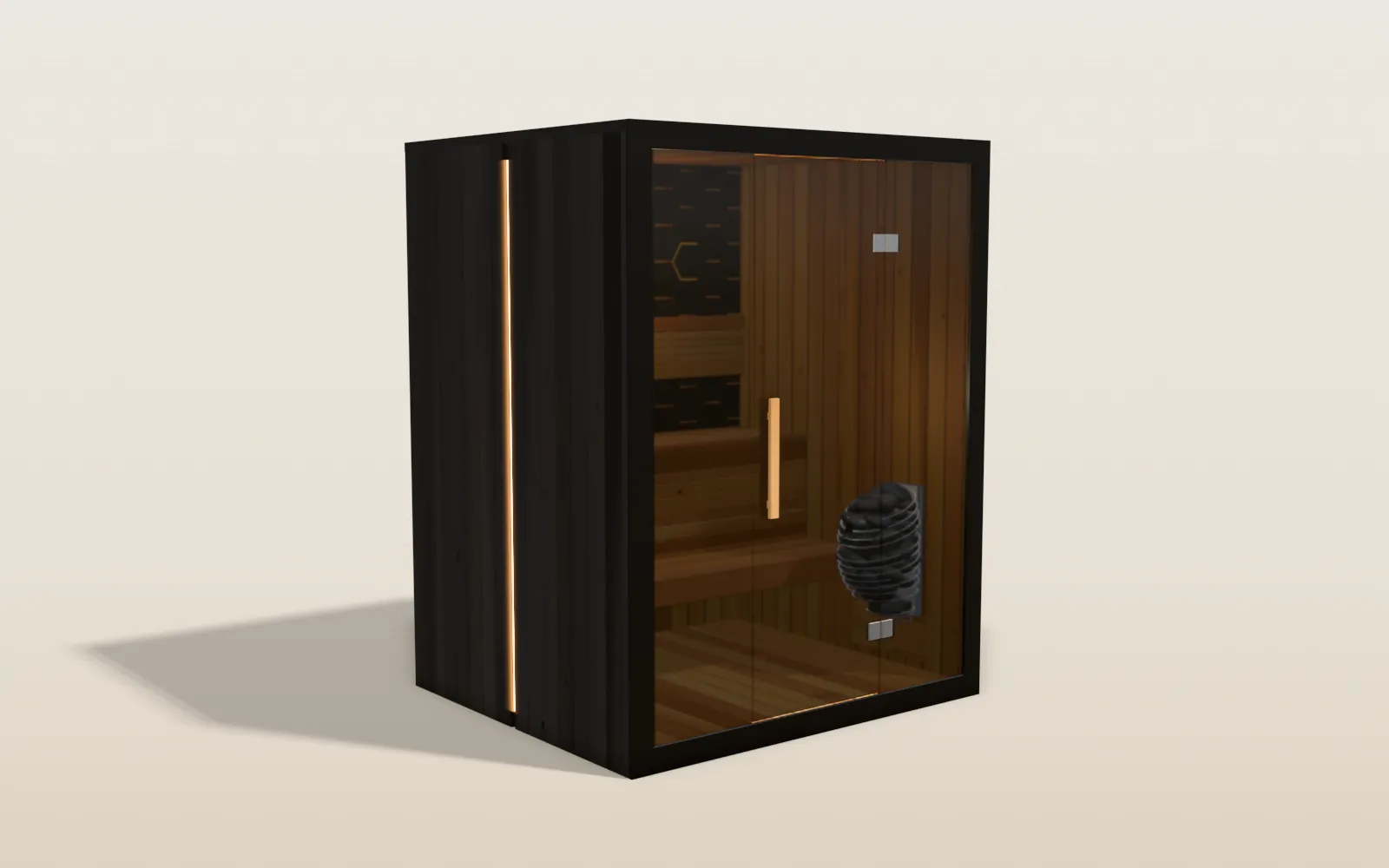
The two benches stand at 17 and 34 inches, and the upper one sits in the hottest air. Black glass fills the front of the cedar cabin.
The warranty's the weak spot. Sun Home's terms pay for parts and never for labor, and its lifetime cover on the cabinetry means seven years. HUUM covers the heater for three years and treats the heating elements as consumables.
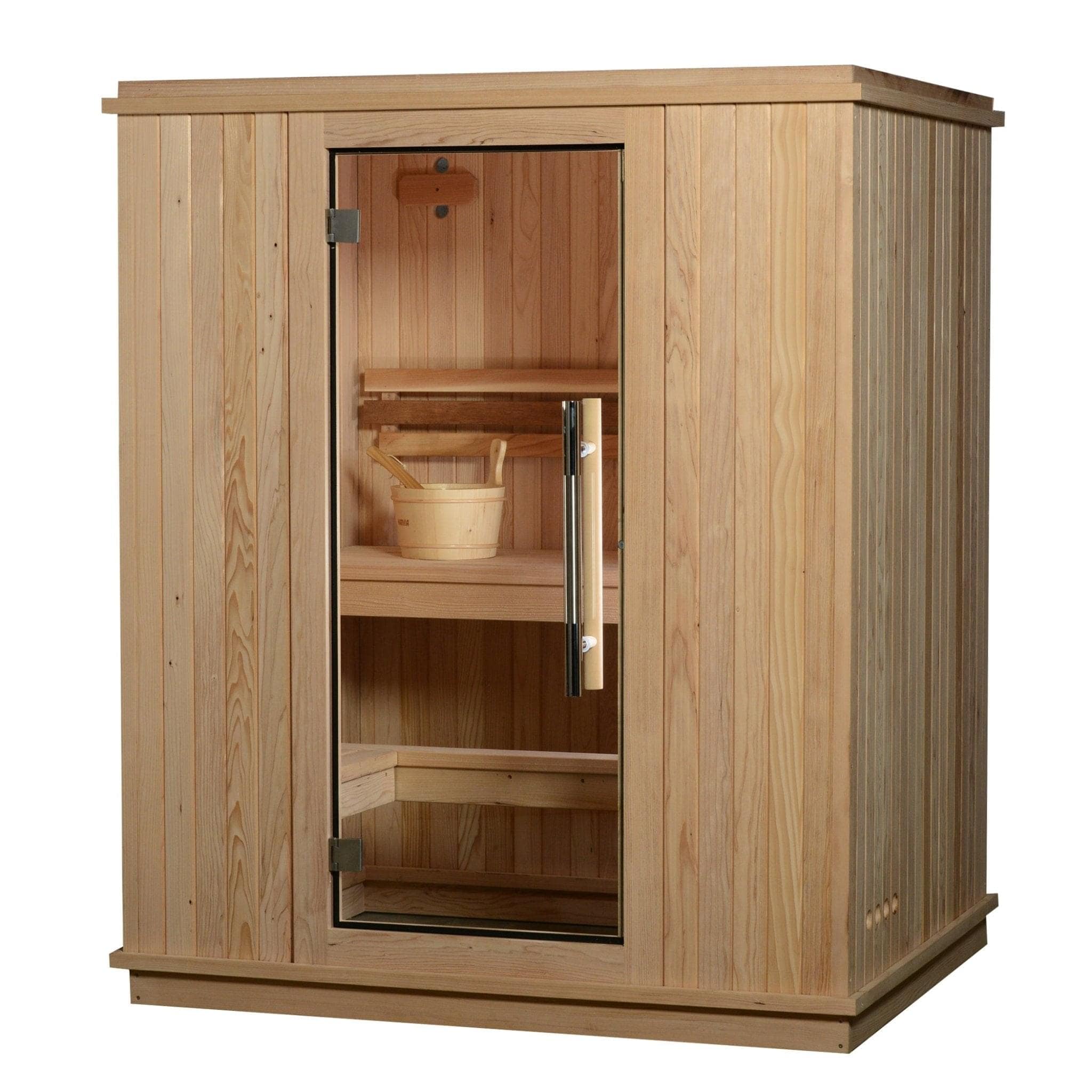
The Nova is hardwired, so an electrician runs a dedicated 240V circuit on a 30A breaker, or 40A for the six-person Nova 6. On a tighter budget, Almost Heaven rates its cedar Madison for two or three, and Select Saunas sells it with its Harvia heater for $4,786. The Madison's hardwired too, and its kit leaves out the floor, so the room stands on yours.
Outside
Sun Home uses thick black glass for privacy and says it holds the heat better. The door in the middle is a sheet of the same glass.
A cedar bar on each side of the glass makes the handle. Sun Home says the small gap around the door is there by design.
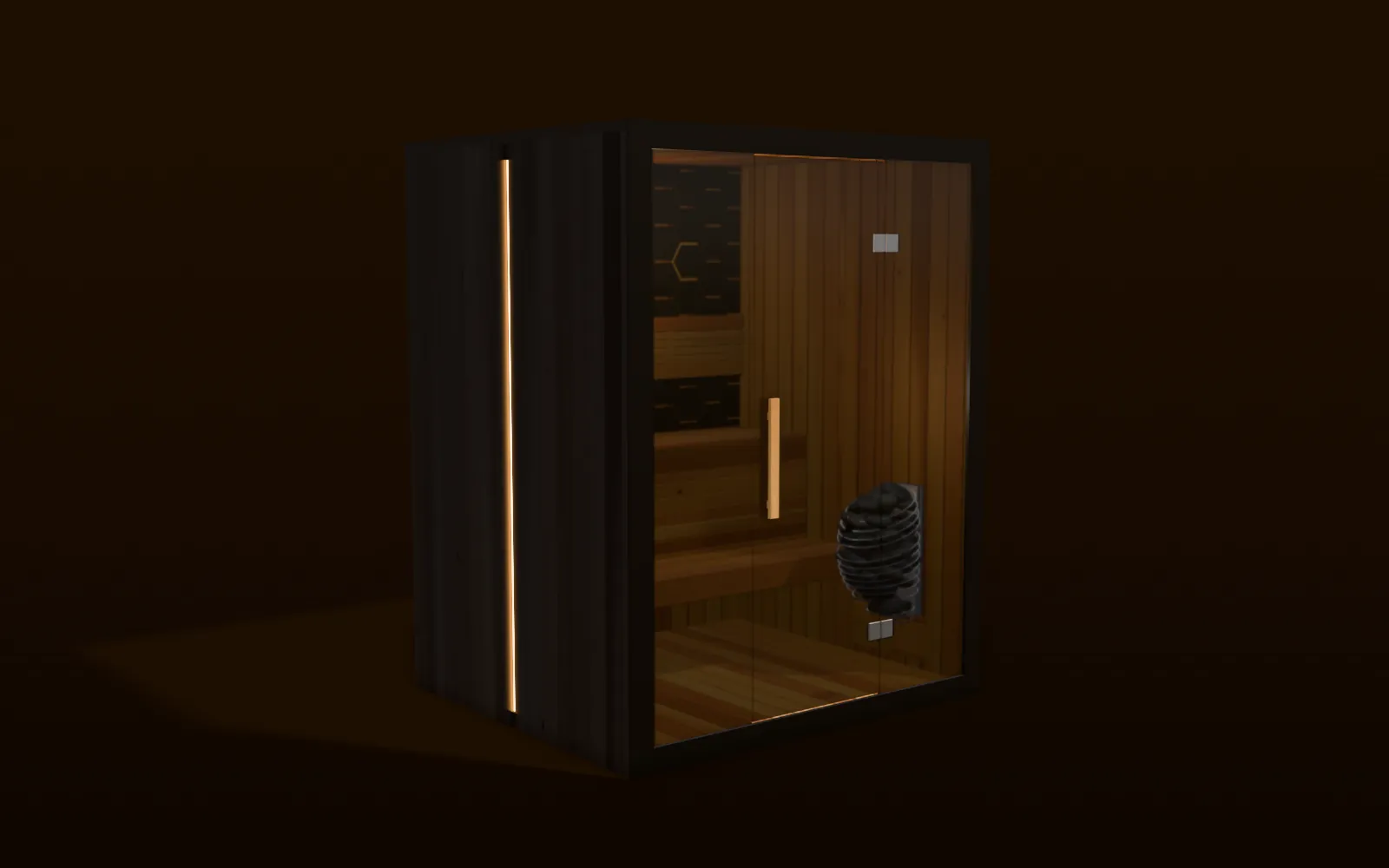
Sun Home heat-treats the cedar and finishes the outside in a water-based black stain it describes as low-VOC. The fasteners are marine-grade stainless steel, and a warm light strip runs up a groove in each side.
It runs on 240V, and a licensed electrician makes the connection. The heater and controls ship separately, and Sun Home wants every part on site before the electrician starts. Leave 12 inches on the right for the air intake and 30 inches in front for the door. Sun Home asks for two feet on the left only beside a finished wall, and two feet overhead so the electrician can reach the ceiling connections.
Inside
HUUM's DROP holds its stones in a ball of thin steel rings, and this one is the 6 kW model. Ladle water on the stones for steam. Sun Home rates the room to about 230°F and puts the heat-up at around an hour.
Sun Home pitches the pair as a hot upper zone and a milder lower one, so two bathers can pick their heat. Inside, the Nova 3 measures 59.1 by 53.5 inches.
Sun Home says the carbonized tiles are handcrafted in Estonia and laid by hand. Warm LEDs behind two of them light the joints around each one.
It sets the heat and the session. HUUM's app does the same over 2.4 GHz Wi-Fi once someone has confirmed at the panel that the room is safe, so the room can warm up before you're home.
Fresh air comes in through a grille low on the heater side, and the fan on the far wall pulls it across the room. Sun Home says to expect some warmth and humidity in the room around the sauna.
They run apart from the tile lights, and a remote changes the color.
We built this model from Sun Home's 3D tour and spec sheet, so small details can differ from the sauna that arrives.
Where to buy

Sun Home Saunas Indoor Saunas
Sun Home Nova 3-Person Indoor Traditional Sauna

Sun Home Saunas Indoor Saunas
Sun Home Nova 6-Person Indoor Traditional Sauna
Almost Heaven Saunas Indoor Saunas
Almost Heaven Madison 2-3 Person Indoor Sauna


Sun Home Nova 3-Person Indoor Traditional Sauna. Sun Home Saunas photography.
See the specifications and priceNootka's Cube is our pick for an outdoor traditional sauna
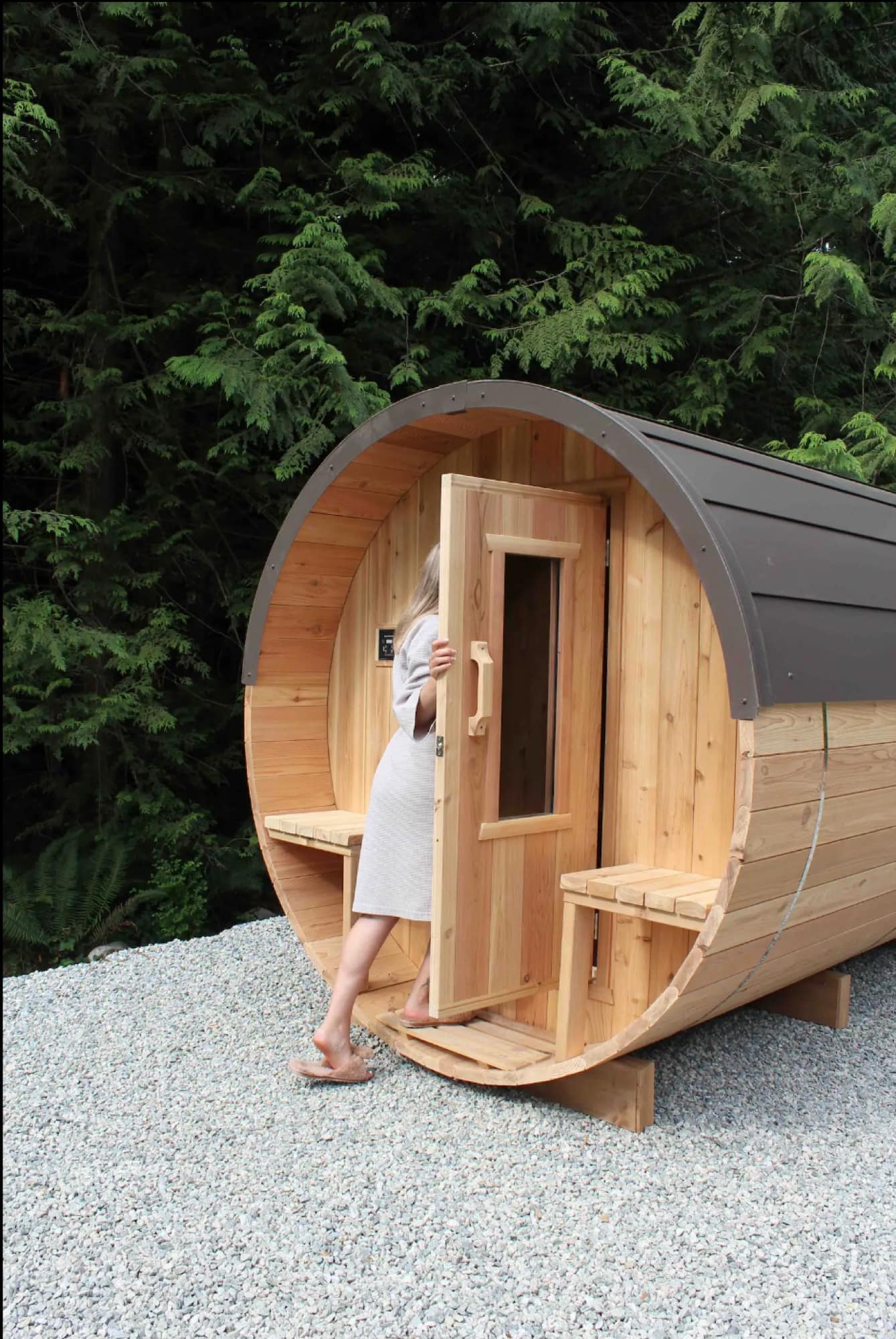
Outside, our pick is Nootka's Cube. Nootka rates the square cedar room for five on two tiers of benches, and the upper tier sits high enough to catch the heat that gathers under the roof. Its price starts at $13,250 and covers Nootka's 9 kW heater and stones along with the metal roof and a big window.
Warm-up is where Nootka's own page wanders. It gives anywhere from 25 to 45 minutes to reach 194°F (90°C) and doesn't say how cold the room started, so plan on the longer end. Nootka's FAQ puts the heater on a hardwired 50-amp breaker, and putting a GFCI on that breaker voids its warranty.
The Cube costs about $3,800 more than Nootka's 8ft barrel once the barrel gets the same roof and a big window, and it can't take a wood stove. Nootka's warranty covers the heater and controller for two years, and only for parts in the second.
For less money, the 8ft barrel seats four from $8,200, and Nootka quotes 10 to 15 minutes to heat it, again without a starting temperature. You can order it with a Harvia wood-burning stove for a little more, which takes the seating down to two or three. Freight and assembly are added at checkout on both.
Where to buy

Nootka Saunas Outdoor Saunas
Nootka Cube Sauna
“You buy this inch-and-a-half cedar cube once and pass it down.”

Nootka Saunas Outdoor Saunas
Nootka 8ft Barrel Sauna
“On-site assembly where Nootka offers it makes this thick cedar barrel worth its higher price.”
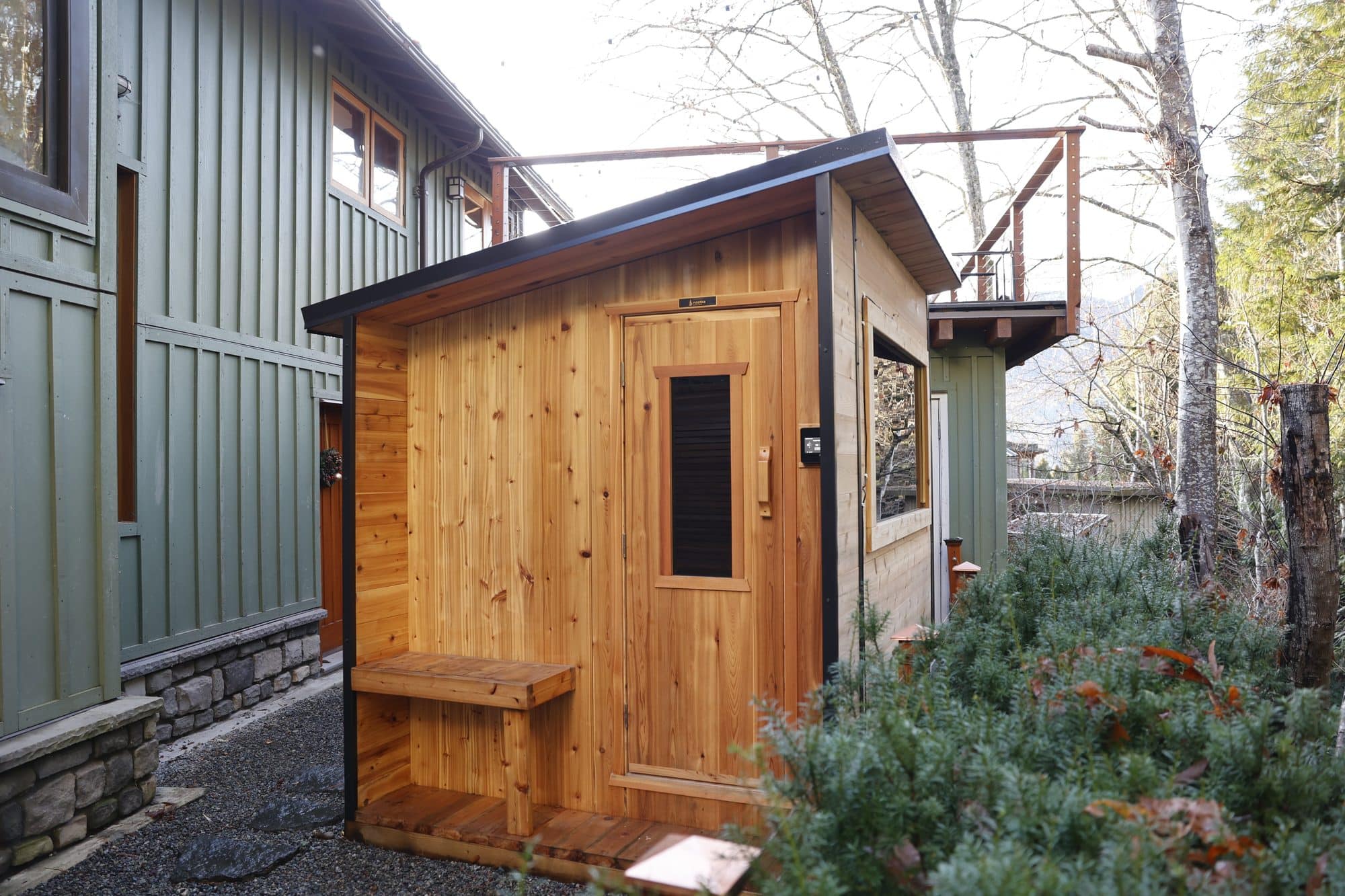
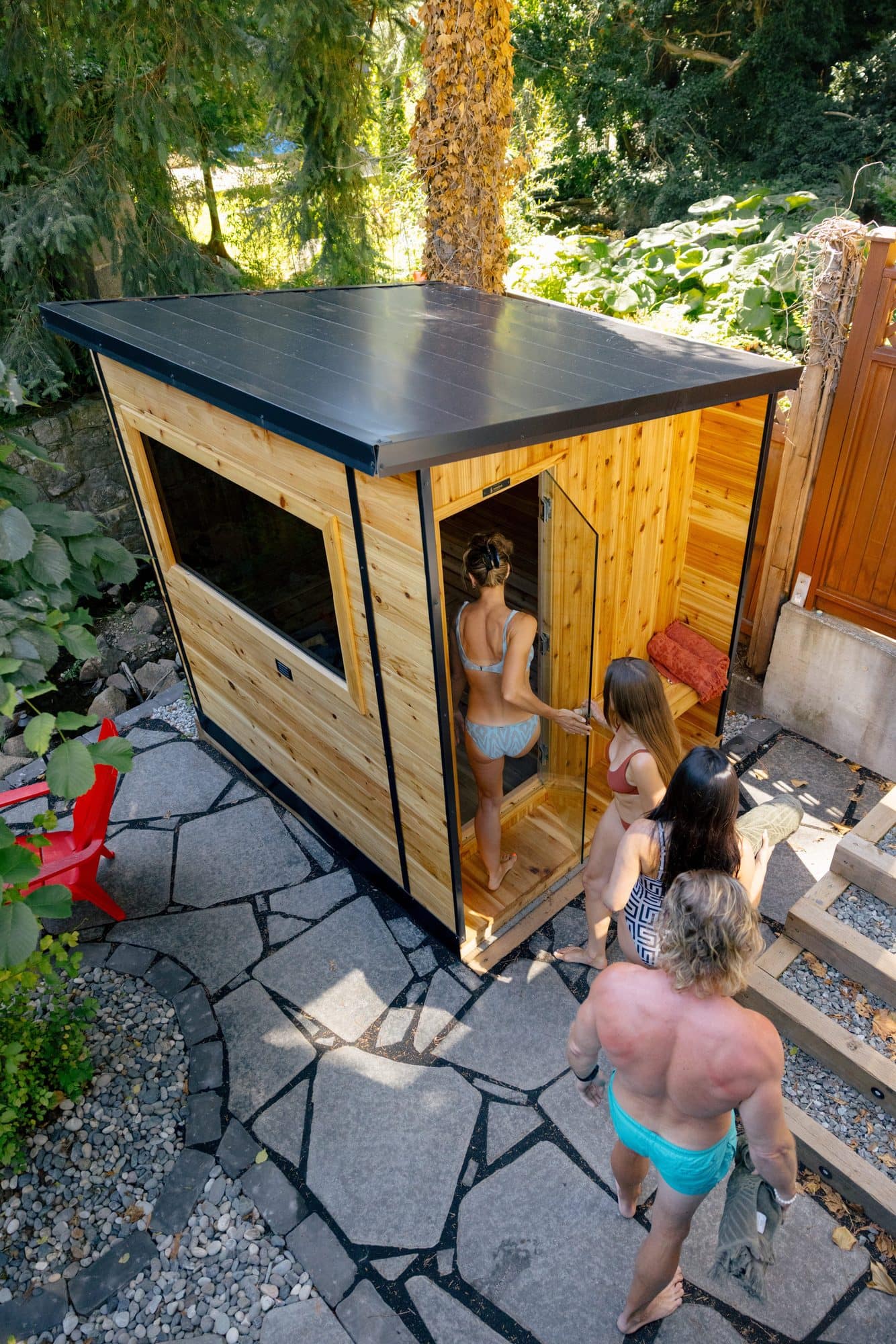
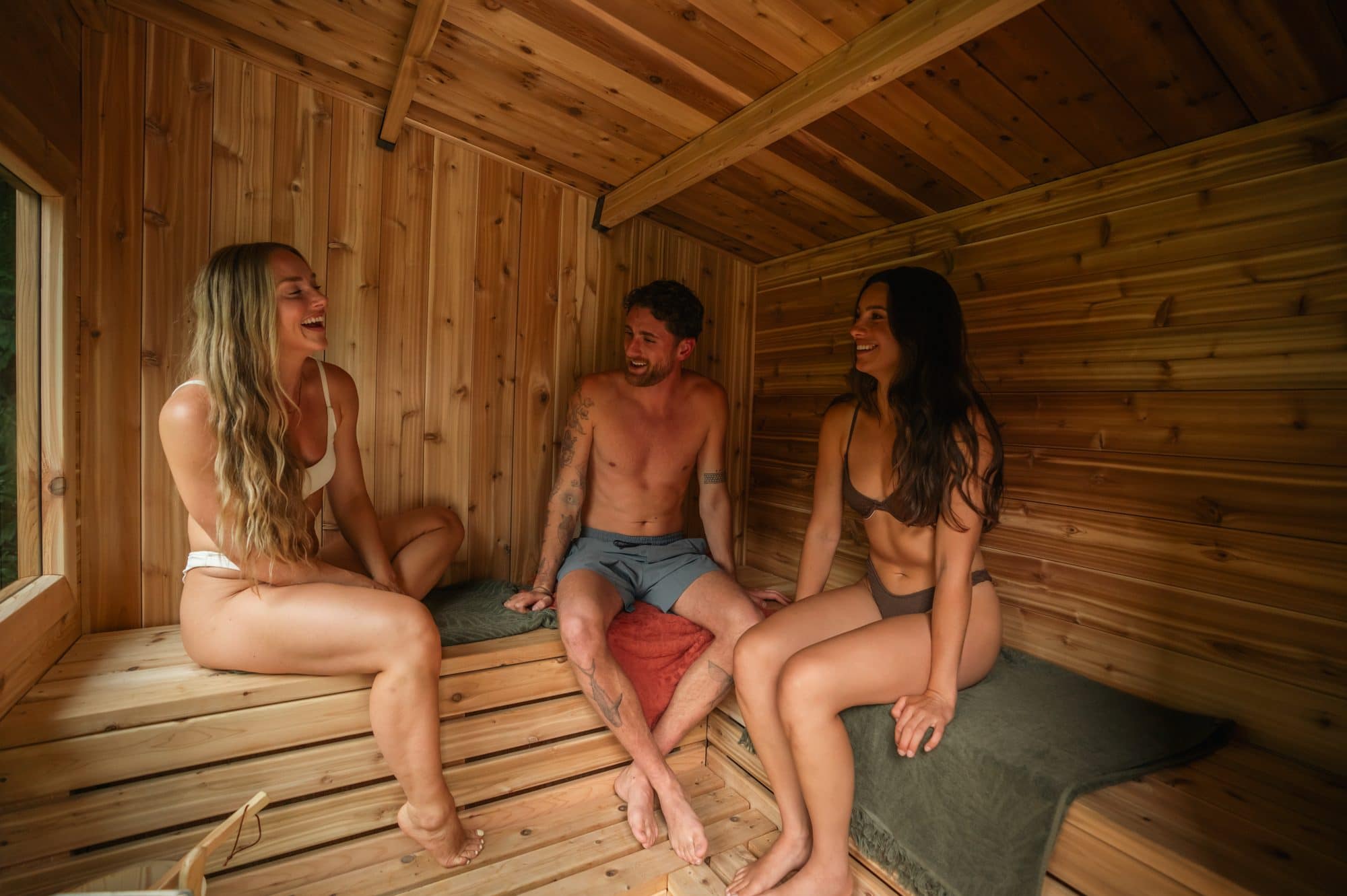
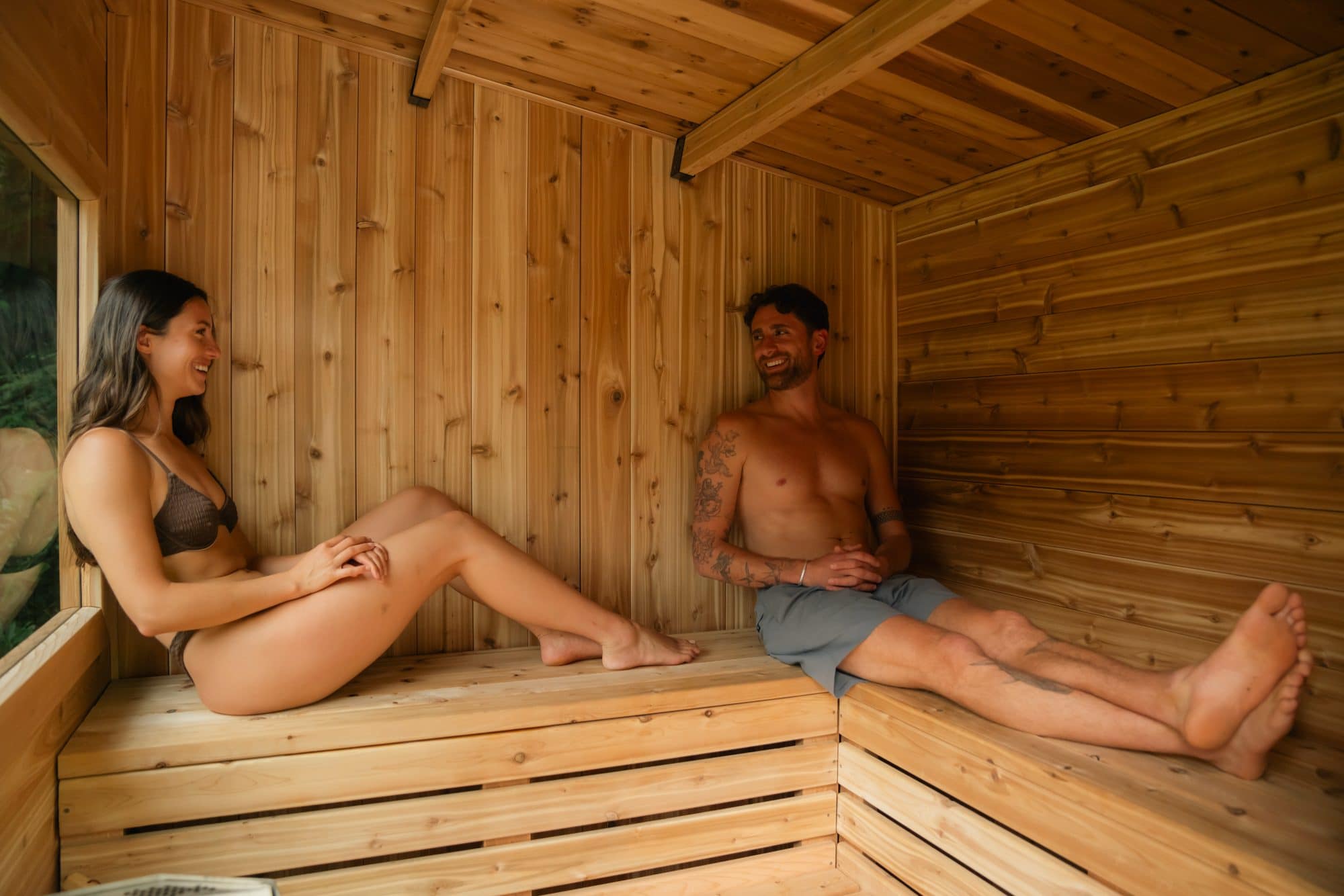
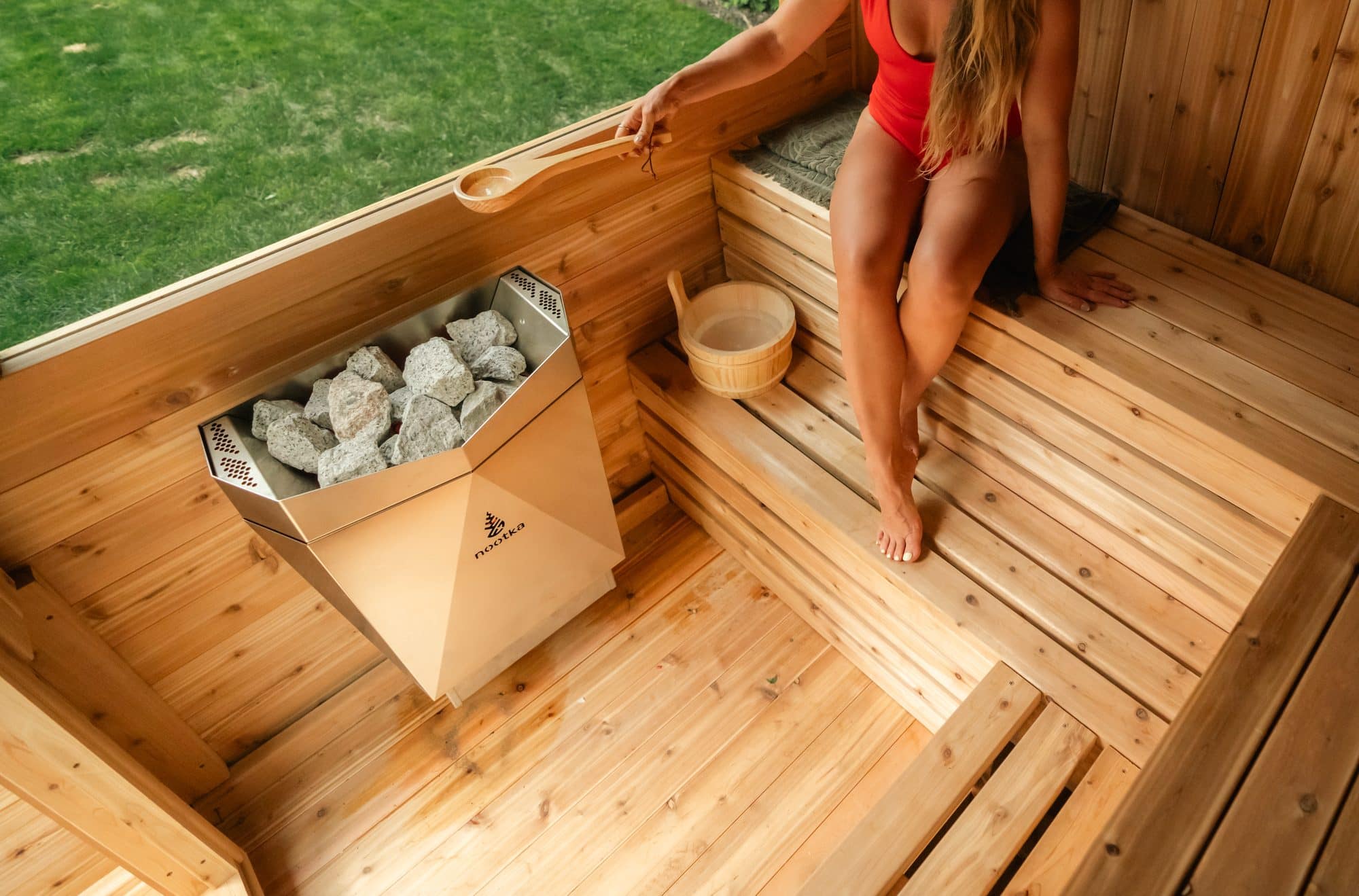
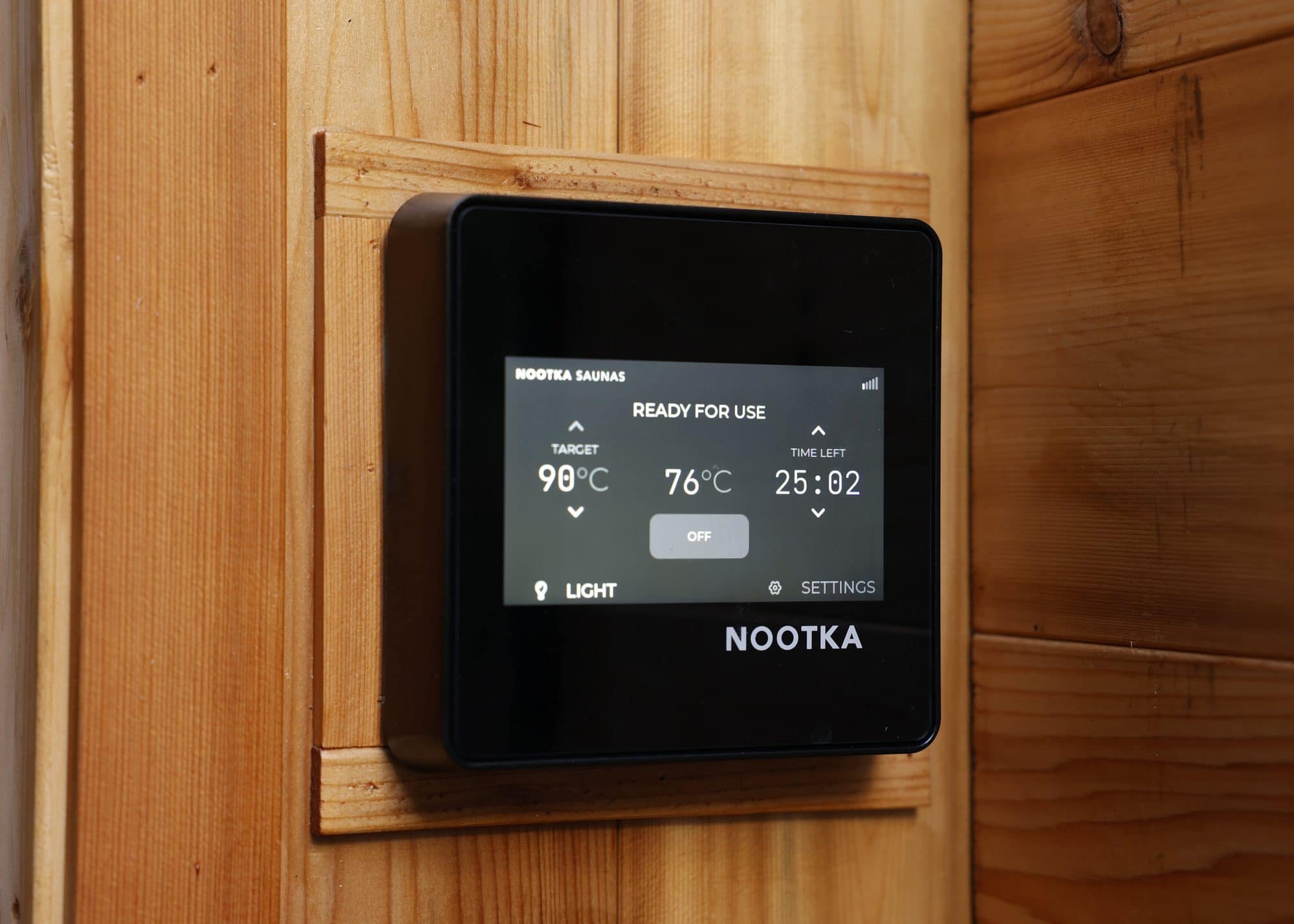
Nootka Cube Sauna. Nootka Saunas photography.
See the specifications and priceFor infrared, we'd start with Sun Home's Equinox 2
The Equinox 2 is the cabin we'd start with for a couple who want far-infrared and full-spectrum heat on a 120-volt circuit, with a price on the page. It costs $6,799 and puts four far-infrared panels behind and beside the bench, with a full-spectrum heater standing in each front corner, and it wants a 20-amp circuit of its own. Sun Home's warranty gives the cabinetry and heaters seven years. If three of you will use it, the Equinox 3 is $900 more.
Its weak spot sits by your knees. Sun Home's manual says the front-corner heaters can scorch bare skin, so keep your legs well back from them. The cabin's slow to warm up as well, at about a degree a minute by Sun Home's count, so a full-heat session starts half an hour after you switch it on.
Price two other brands before you order. Health Mate's Enrich 2 is cheaper at $5,300, in mahogany with a near-infrared LED array overhead, though Health Mate doesn't say what wavelengths that array uses. Its rated draw takes nearly all of a 15-amp circuit, so there's no room for anything else on the line.
Good Health Saunas offers the GHS-2X in hemlock or red cedar. Its spec sheet wants a 20-amp circuit to itself. There's no price on Good Health's site until you fill in a form, so ask for the price and the delivery charge in writing. Our infrared guide sets all three against Heavenly Heat's and Dynamic's cabins.
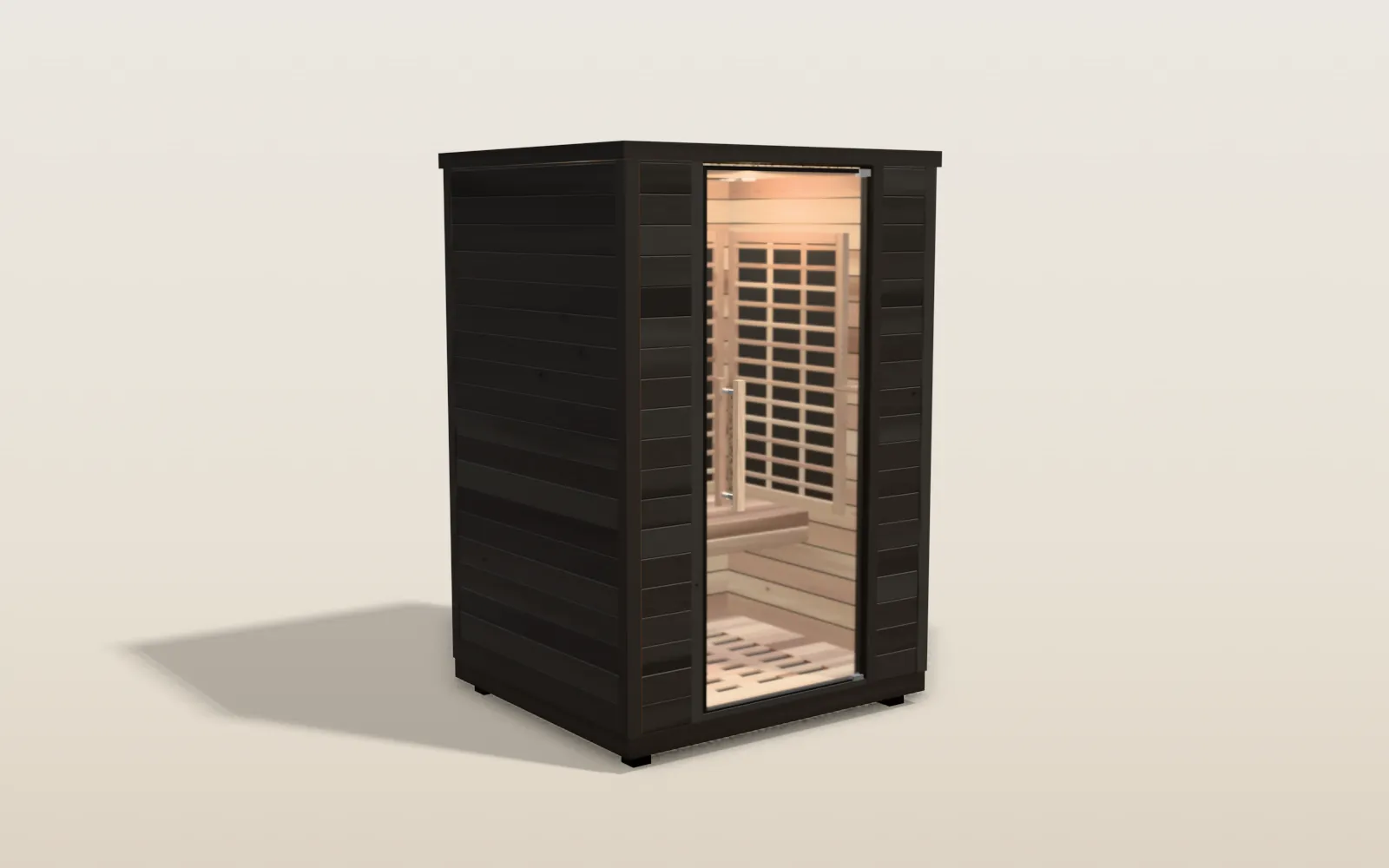
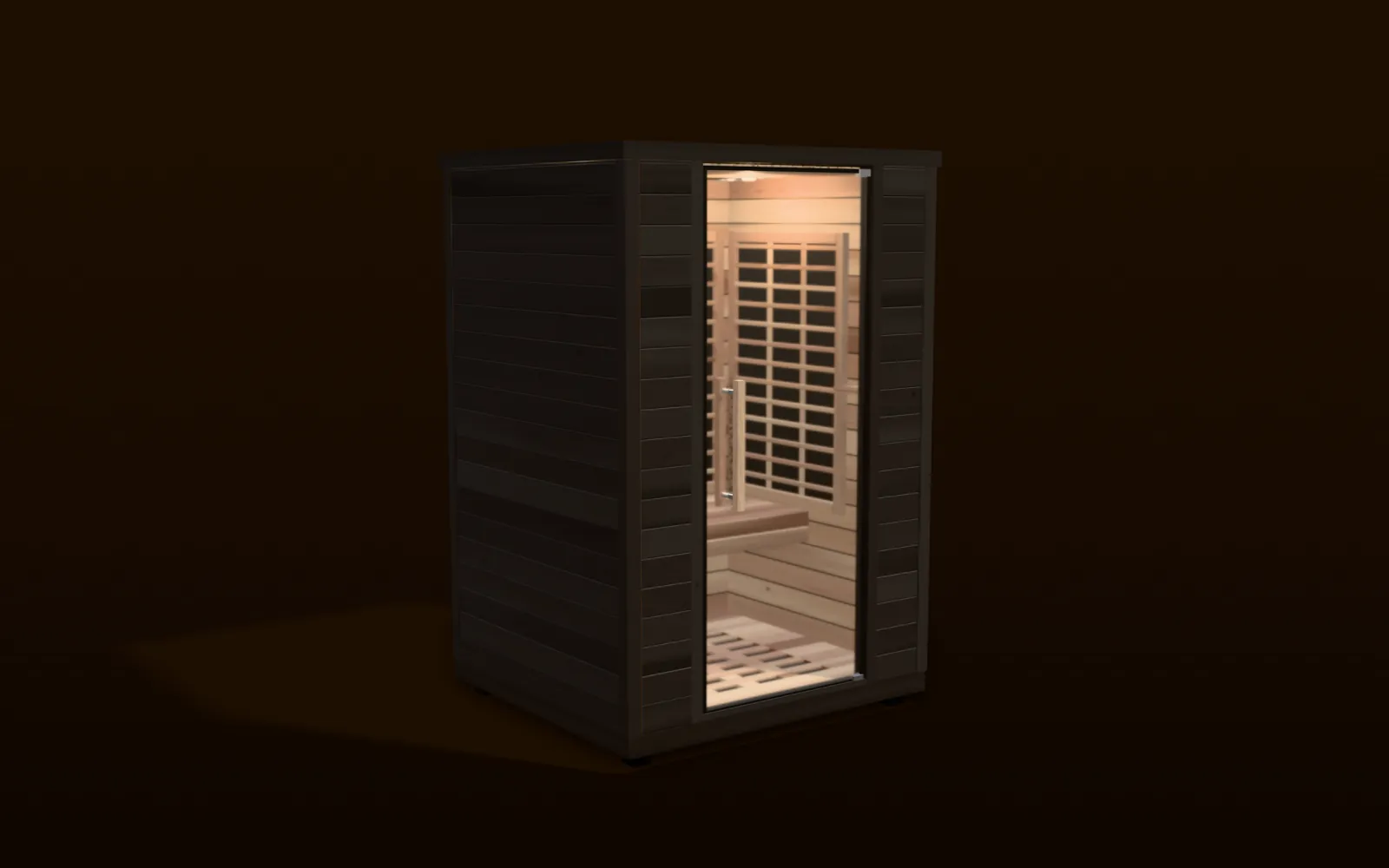
Outside
It's one sheet of glass on two hinges, with a pull handle inside and out.
Sun Home builds it from kiln-dried eucalyptus with a black finish outside. The cabinet measures 50.9 by 45.9 inches and stands 77.7 inches tall on its feet.
Sun Home put it outside so the cabin can warm up before you get in. The main controls are on the inside wall.
It's 10 feet long and needs a dedicated 120V, 20A outlet (NEMA 5-20), so put that outlet on this side of the room.
Give it a level, dry floor indoors with room on every side. It weighs 541 pounds.
Inside
Two sit behind your back and one on each side, all behind a wooden grid.
It's 45 inches long, with a full-spectrum heater standing in each front corner.
It sets the temperature and the session time, and one button steps the full-spectrum heaters through their levels. The far-infrared panels run whenever the sauna is on. Sun Home rates the Equinox to 165°F.
Each is a 500-watt cabinet angled at the bench, with tubes that cover the spectrum from near infrared to far. Sun Home sells the system as True Wave.
Two chromotherapy lights sit in front of a pair of Bluetooth speakers, so your own music can play through a session.
We built this model from Sun Home's 3D tour and spec sheet, so small details can differ from the sauna that arrives.
Where to buy
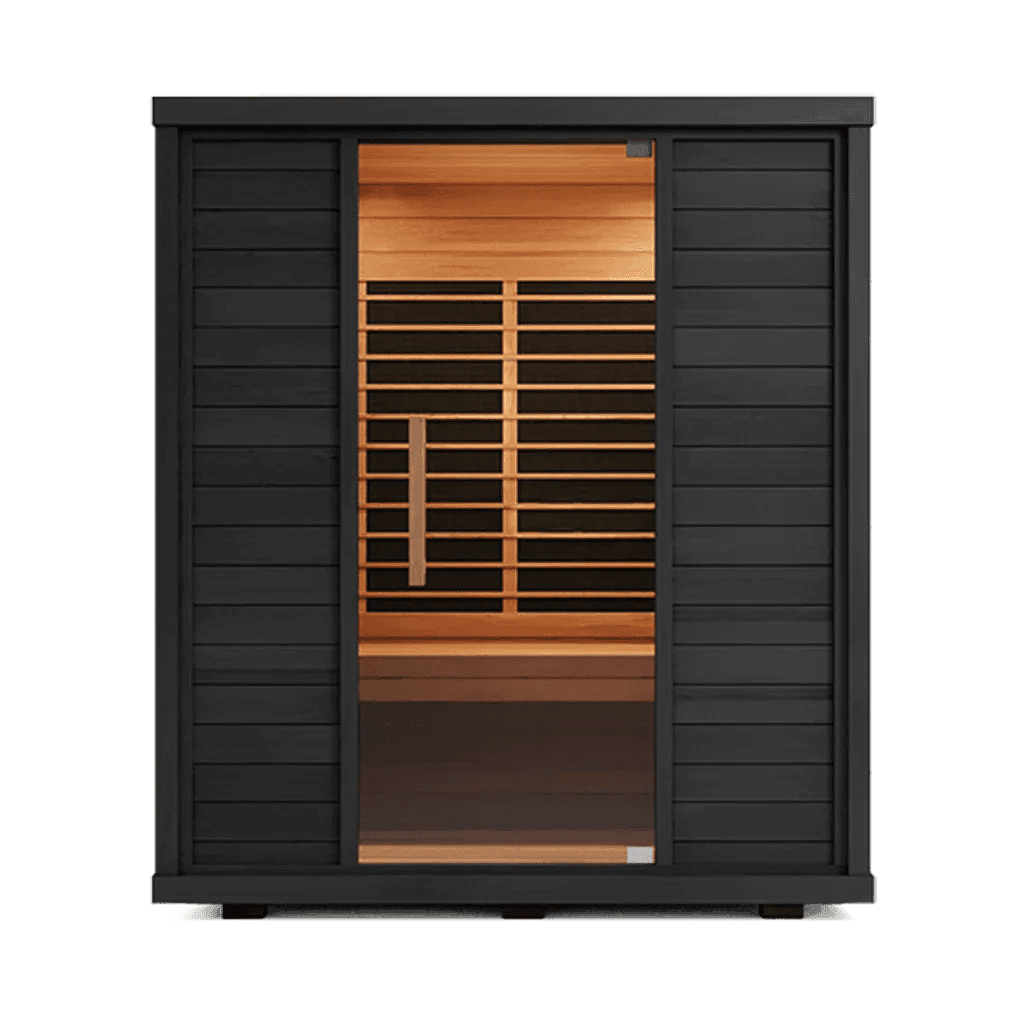
Sun Home Saunas Infrared Saunas
Sun Home Equinox 3-Person Full-Spectrum Infrared Sauna
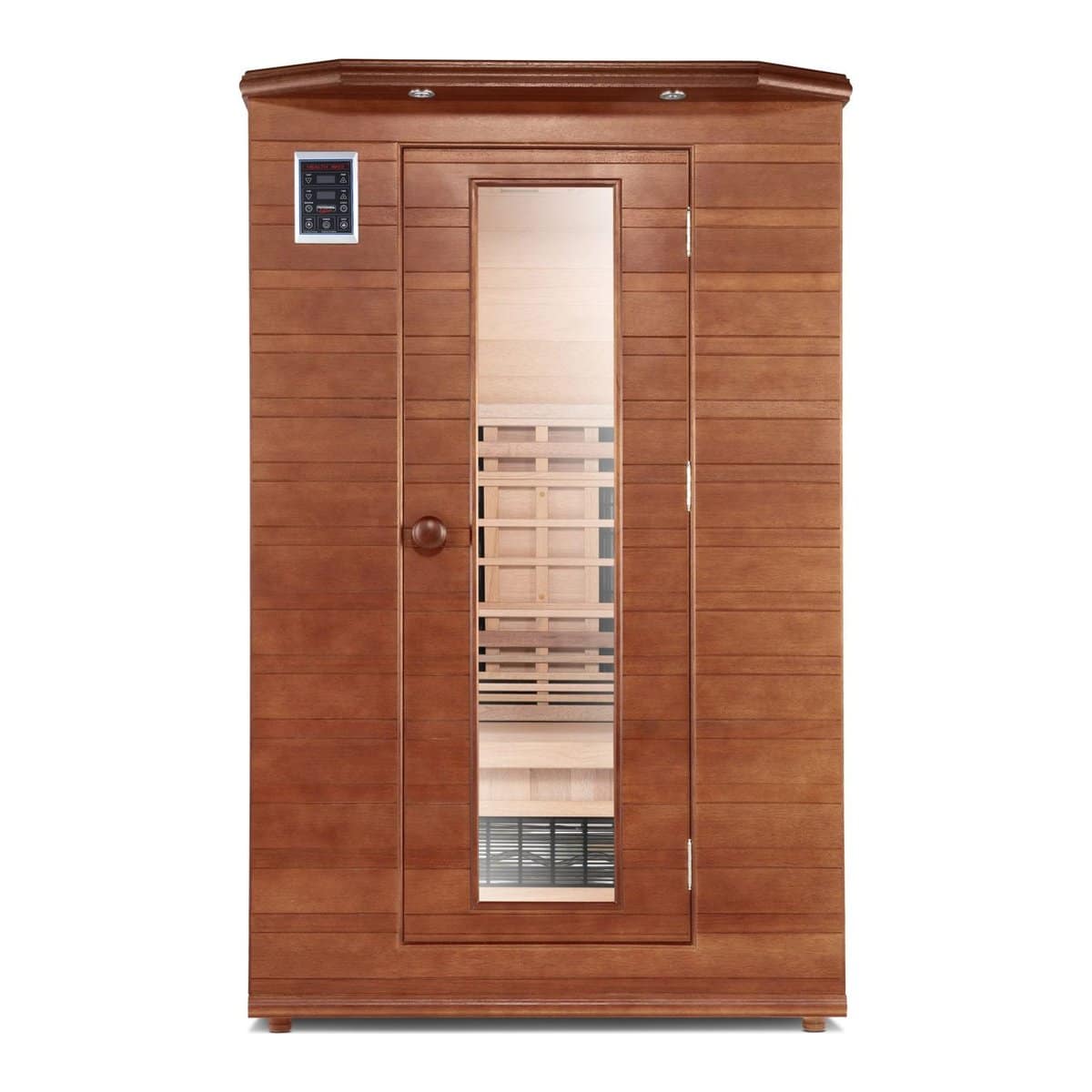
Health Mate Infrared Saunas
Health Mate Enrich 2 Full-Spectrum Infrared Sauna
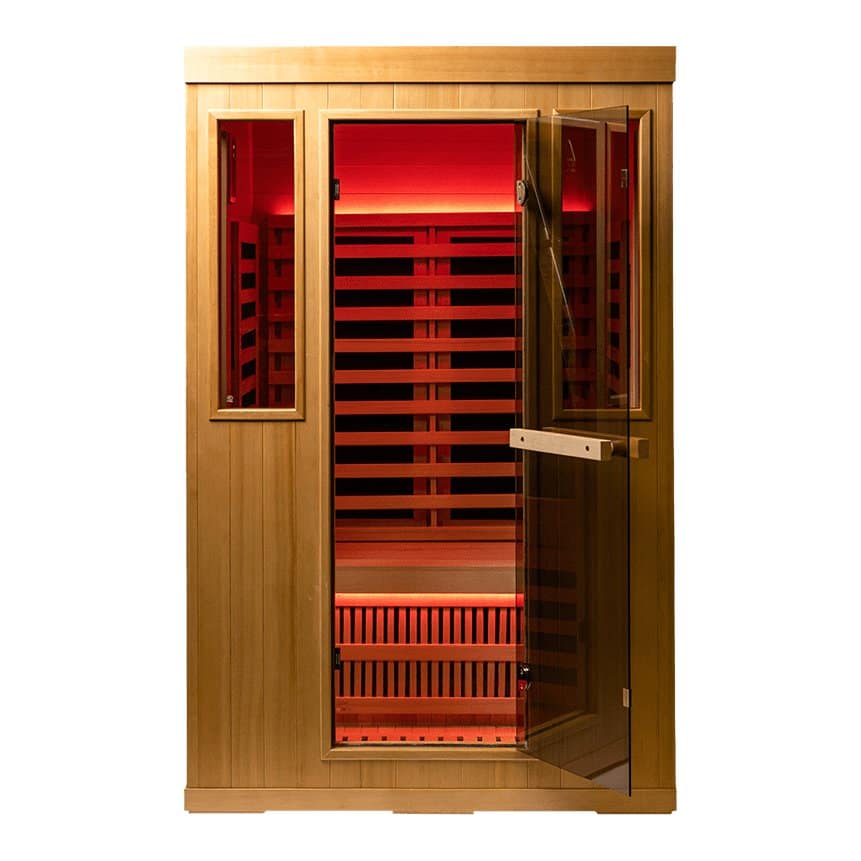
Good Health Saunas Infrared Saunas
Good Health Saunas GHS-2X Hybrid 2-Person Infrared Sauna
Sun Home's Eclipse puts red light panels inside a full-spectrum cabin
Buy the Eclipse 2 if you came for the red light. It costs $10,599, and Sun Home stands two red light panels inside the front glass and lists them at 650 and 850 nm. Six far-infrared and two full-spectrum heaters do the heating. A four-person Eclipse 4 runs $13,599 and doubles the heaters with the same pair of panels.
The Eclipse 2 costs $3,800 more than the Equinox 2, and the light panels are only part of that. It also gets two more far-infrared heaters and app control, and its cabin is Japanese cedar where the Equinox uses eucalyptus.
Take Sun Home's light output figure as a claim. The listing gives an irradiance with no method, and Sun Home's own optical report left the LEDs out.
Check the outlet before you order. Sun Home's spec sheet puts the Eclipse 2 on a dedicated 30-amp circuit at 120 volts with GFCI protection and a twist-lock outlet. The Eclipse 4 needs the same kind of circuit at 240 volts, and Sun Home wants a licensed electrician to install it.
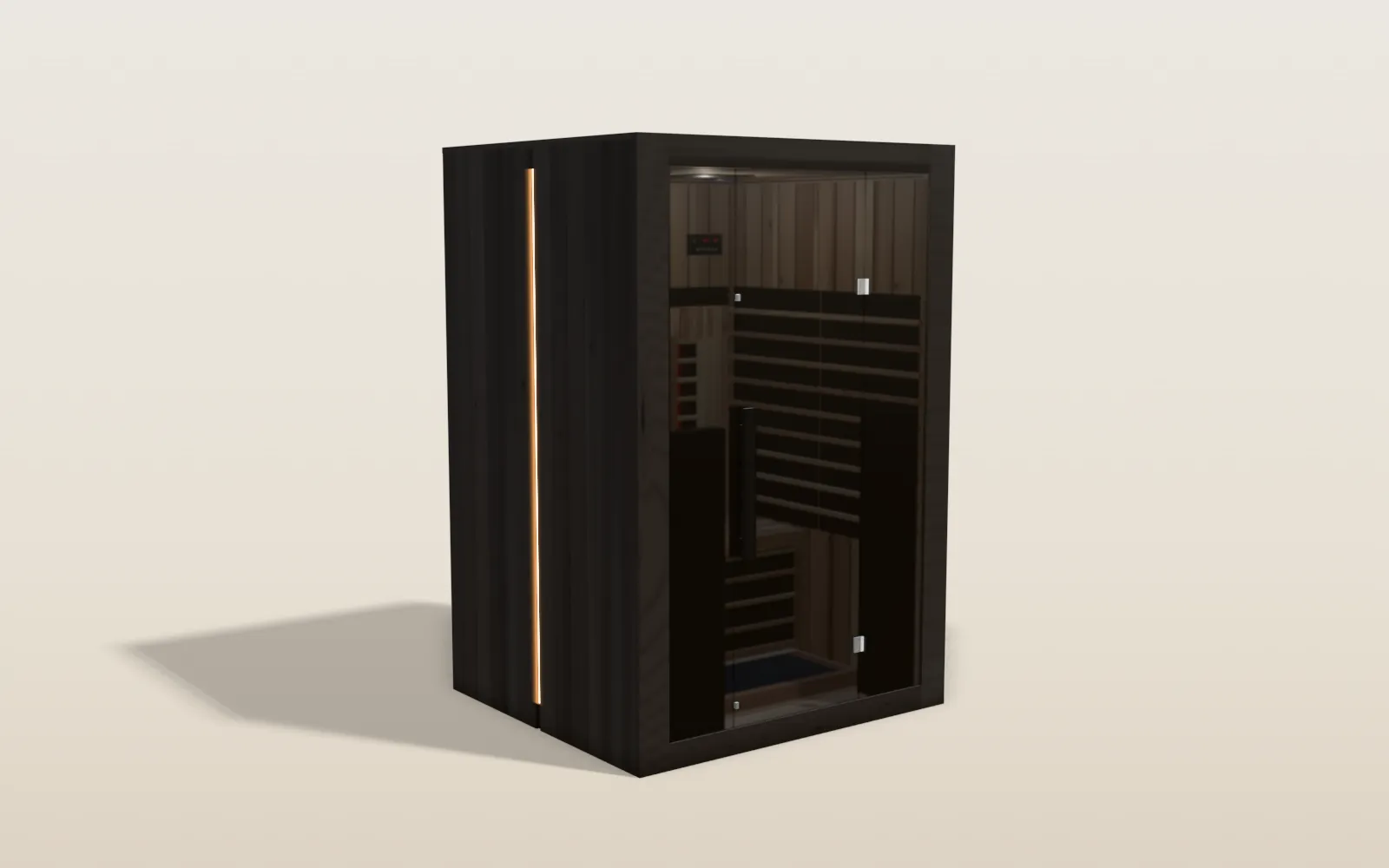
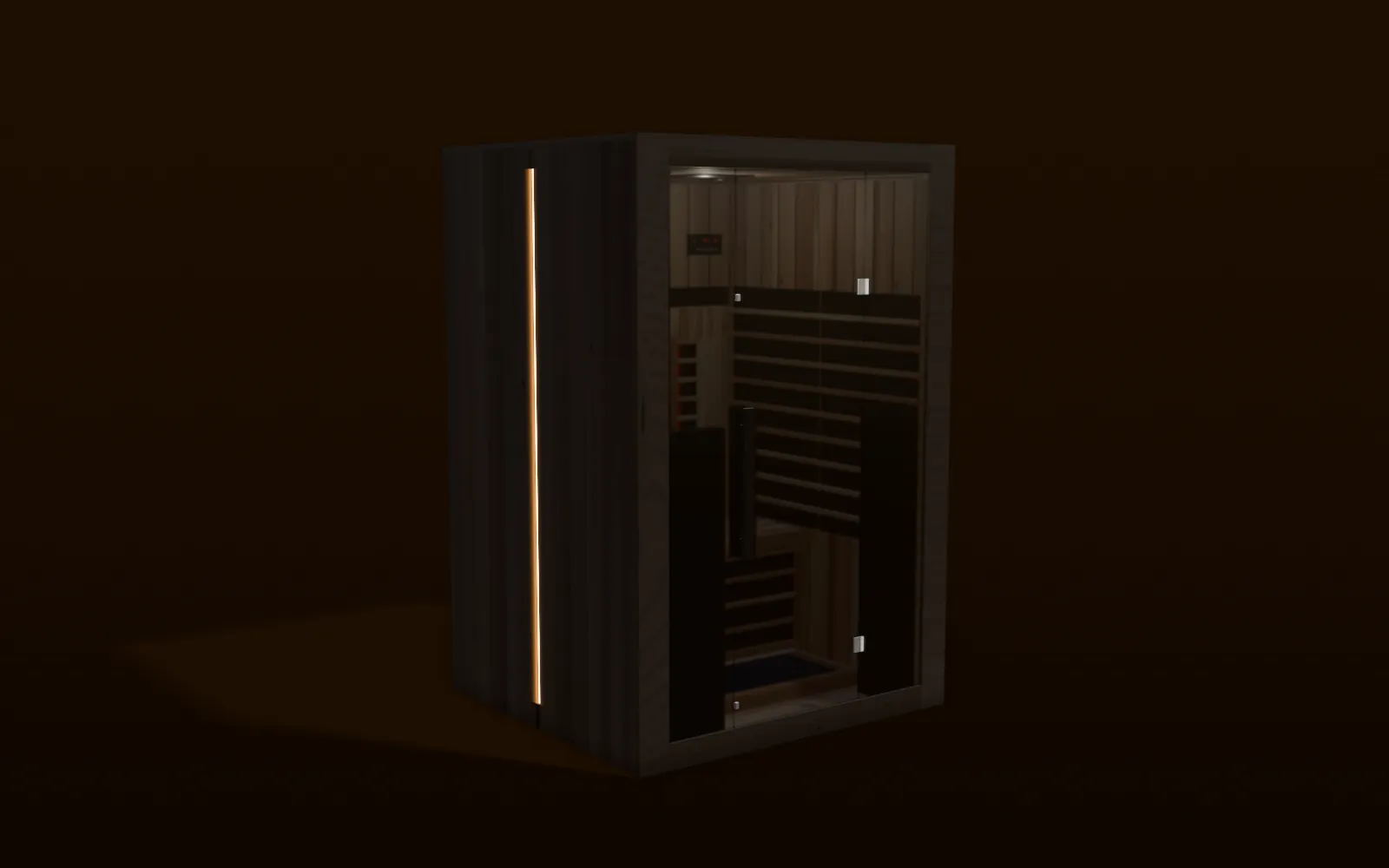
Outside
The door in the middle hangs on glass hinges and shuts on a magnetic gasket. Sun Home says it closes securely without resistance.
Sun Home builds the cabin in Japanese cedar with a double wall. The Eclipse 2 measures 51.5 by 47.2 inches, stands 76.7 inches tall and weighs 600 pounds.
The control panel has its own key for the outside lights.
Its 9.5-foot cord leaves the top of the back panel and ends in a NEMA L5-30 twist-lock plug. It draws 2,820 watts, and the outlet needs GFCI protection.
Inside
Each one sits between the two boards of a contoured backrest. Sun Home says their output runs from near infrared to far.
Its two knobs set the strength of the full-spectrum heaters behind the backrests. Sun Home's app can switch the far-infrared and full-spectrum heaters on their own as well.
They shine at 650 and 850 nm and have their own controls on the side. Sun Home's manual suggests 20 minutes at 6 to 24 inches, at least three times a week.
Sun Home counts six far-infrared heaters in the Eclipse 2. Two sit on each side wall, one warms your calves from the front of the bench and one lies in the floor.
A far-infrared calf panel fills its front behind three slats. Inside, the Eclipse 2 measures 42.8 by 42.2 inches.
It sets the temperature up to 165°F and the session timer. Keys on it switch the colored ceiling light and the lights under the bench, and music plays over Bluetooth.
The RGB key on the panel or Sun Home's app picks the color, and the white setting cycles through all of them.
We built this model from Sun Home's 3D tour and spec sheet, so small details can differ from the sauna that arrives.
Where to buy

Sun Home Saunas Infrared Saunas
Sun Home Eclipse 2-Person Red Light & Full-Spectrum Infrared Sauna

Sun Home Saunas Infrared Saunas
Sun Home Eclipse 4-Person Red Light & Full-Spectrum Infrared Sauna
How did we compare them?
We compared six saunas from five brands in the examples table, three of each kind, and the sections add Sun Home's Eclipse and two Golden Designs cabins sold as Dynamic and Maxxus. Product figures come from what each maker publishes about its own saunas, and Select Saunas' listing covers the Madison. We read them all on Oct 7, 2026. We haven't found a test that puts these saunas next to each other, so the temperatures and warm-up times here are the makers' claims.
The running costs are our arithmetic on the makers' power ratings, with every assumption printed in the table. We priced electricity near the latest US residential average from the EIA.
For the research we read the JAMA paper's abstract and the full stroke and dementia papers in the University of Bristol's repository. The WAON-CHF trial is free to read in full on J-STAGE. None of the four studies tested a home sauna, and we didn't rest any pick on a health claim.
Hear it from the source
The ULTIMATE Guide to Saunas & Heat Exposure | Dr. Rhonda Patrick
FoundMyFitness gathers Rhonda Patrick's sauna guidance into one overview. It covers benefits and protocols, and it compares traditional heat with infrared.
Common questions
- Is infrared or traditional sauna healthier?
- Neither has been shown to be healthier for someone using a sauna at home. The long-term studies followed Finnish adults in traditional saunas and found associations, which can't prove the sauna caused the difference. The WAON-CHF trial of far-infrared therapy treated hospital patients with heart failure in supervised sessions. If you have a heart condition, ask your doctor before you use either kind.
- Does a traditional sauna get hotter than infrared?
- Yes. A traditional Finnish sauna usually runs at 80 to 100°C (176–212°F) at face height, and a far-infrared cabin nearer 60°C (140°F). The infrared cabins in this comparison are rated to 170°F at most by their makers. Those figures describe the air, and your body stays far cooler in either room.
- Is infrared cheaper to run than a traditional sauna?
- Usually, yes. An infrared cabin draws far less power than a traditional heater. By our math, Sun Home's 1.88 kW Equinox 2 uses about 2.2 kWh for a 30-minute warm-up and a 40-minute session, about 39¢ at 18¢ a kWh. A 6 kW traditional heater uses about 8 kWh, or $1.44, for an hour's warm-up and the same session, if it draws full power half the time once the room is hot. Multiply your own heater's kW by its hours at full power and your rate to check.
- Is a red light sauna worth it?
- A red light sauna is worth it if you'd otherwise buy a separate red light panel. Sun Home's Eclipse 2 costs $10,599, which is $3,800 more than its Equinox 2, and that gap also buys two more far-infrared heaters and a cedar cabin with app control. Sun Home doesn't say how it measured the Eclipse's light output, so treat its irradiance figure as a claim.
Sources
- 1.Association Between Sauna Bathing and Fatal Cardiovascular and All-Cause Mortality Events. JAMA Internal Medicine, 2015.
- 2.Sauna bathing reduces the risk of stroke in Finnish men and women. Neurology, 2018.
- 3.Sauna bathing is inversely associated with dementia and Alzheimer's disease in middle-aged Finnish men. Age and Ageing, 2017.
- 4.Waon Therapy for Managing Chronic Heart Failure: Results From a Multicenter Prospective Randomized WAON-CHF Study. Circulation Journal, 2016.
- 5.Far-infrared saunas for treatment of cardiovascular risk factors. Canadian Family Physician, 2009.
- 6.Electric Power Monthly: Average Price of Electricity to Ultimate Customers. U.S. Energy Information Administration, 2025.
We review from makers’ documentation, owner reports and published research. How we choose products and write reviews.
We may earn a commission or a fee from brands in this guide. Our picks are our own. How we make money.